Criminal profiling is one of the most fascinating yet complex fields within modern criminal justice. It sits at the intersection of psychology, behavioral science, and law enforcement investigation. A criminal profiler’s role is not to directly solve crimes in the field but to analyze behavioral patterns, crime scenes, and psychological indicators to help investigators narrow down potential suspects.
Understanding how to become a criminal profiler requires more than curiosity about criminal behavior. It demands academic preparation, field experience, analytical thinking, and a deep understanding of human psychology. While popular media often dramatizes the role, real-world profiling is grounded in structured methodologies and evidence-based reasoning.
What Does a Criminal Profiler Do?
A criminal profiler, often working within specialized law enforcement units, studies patterns in criminal behavior to build psychological profiles of unknown offenders. These profiles may include personality traits, behavioral tendencies, demographic indicators, and possible motivations.
Profilers typically collaborate with investigative teams, forensic experts, and law enforcement agencies. Their insights help narrow down suspect pools, prioritize leads, and understand offender behavior patterns in serial or complex cases.
Unlike what is often portrayed in entertainment, profiling is not about “reading minds.” Instead, it is a disciplined analysis of evidence, psychology, and criminology principles.
Educational Path to Become a Criminal Profiler
The journey into criminal profiling usually begins with formal education in psychology, criminology, or forensic science. Most professionals in this field hold at least a bachelor’s degree, while many pursue advanced degrees to gain deeper expertise.

A strong academic foundation typically includes subjects such as abnormal psychology, criminal justice systems, behavioral analysis, research methods, and forensic investigation techniques.
Graduate-level studies, such as a master’s degree in forensic psychology or criminology, significantly improve career prospects. Some professionals also complete specialized training through law enforcement academies or federal agencies.
Essential Skills Required for Criminal Profiling
Becoming a successful criminal profiler requires a combination of analytical, psychological, and investigative skills. Academic qualifications alone are not enough; real-world application of knowledge is essential.
Analytical Thinking
Profilers must be able to interpret complex crime scene data and identify behavioral patterns that may not be immediately obvious. Strong logical reasoning helps in forming accurate hypotheses.
Psychological Understanding
A deep understanding of human behavior, personality disorders, and motivation is essential. Profilers often rely on psychological theories to interpret criminal actions.
Attention to Detail
Small details in a crime scene can reveal significant insights about an offender’s behavior, planning, and emotional state. Missing subtle clues can lead to incorrect conclusions.
Communication Skills
Profilers must clearly communicate their findings to law enforcement teams, prosecutors, and sometimes courts. Their reports must be structured, precise, and evidence-based.
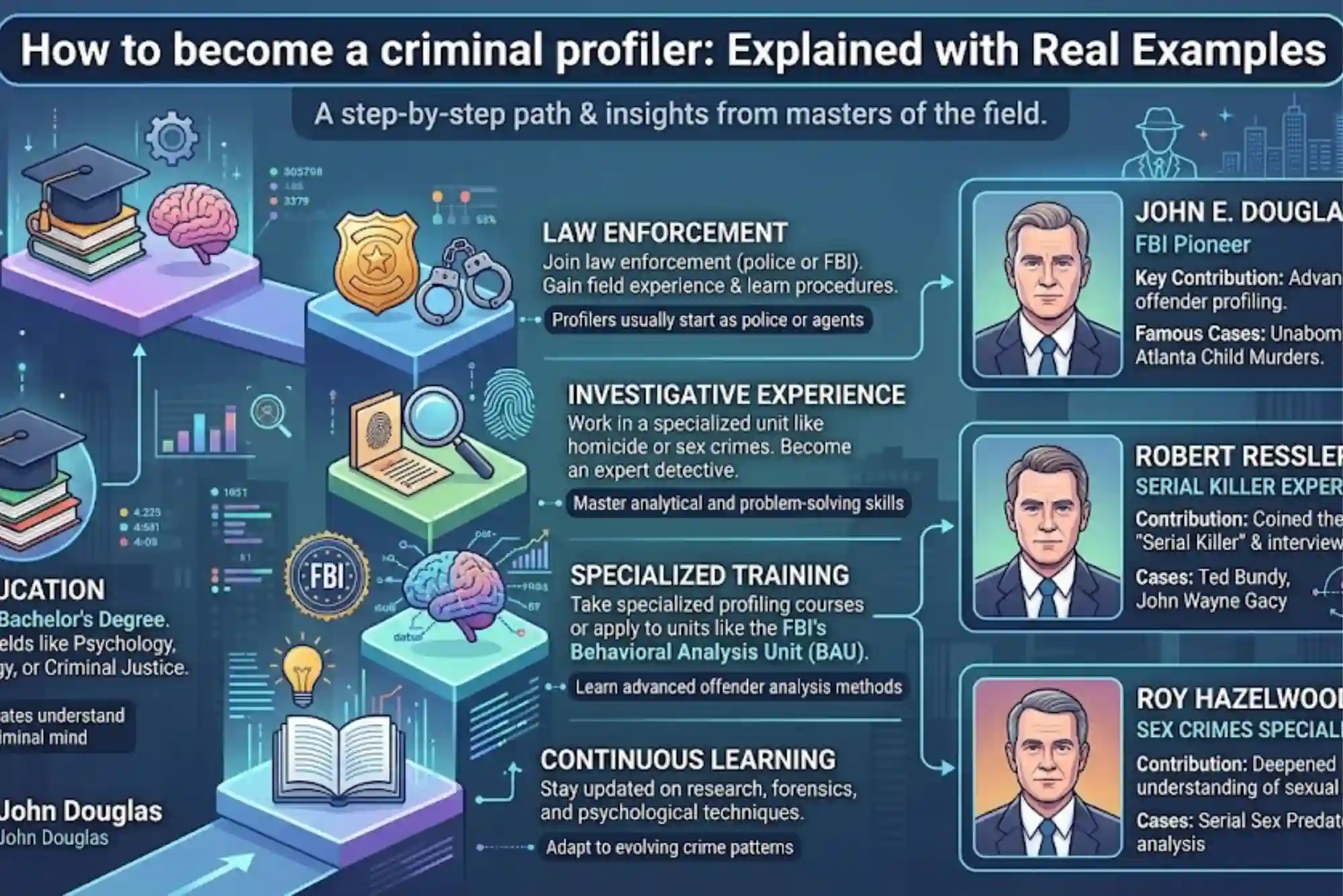
Step-by-Step Career Path
While there is no single fixed route, most criminal profilers follow a structured career progression within law enforcement or related fields.
Step 1: Obtain a relevant degree
Start with a bachelor’s degree in psychology, criminology, or criminal justice. This provides foundational knowledge of human behavior and legal systems.
Step 2: Gain field experience
Work in law enforcement, corrections, or investigative roles. Real-world exposure to crime scenes and criminal behavior is critical for future profiling work.
Step 3: Pursue advanced education or specialized training
A master’s degree or specialized certification in forensic psychology or behavioral science can significantly enhance expertise.
Step 4: Join specialized units
Experienced professionals may transition into behavioral analysis units or similar departments within federal or national agencies.
Step 5: Continuous learning and case involvement
Criminal profiling requires ongoing training, case studies, and collaboration with experienced investigators to refine analytical accuracy.
Real-World Examples of Criminal Profiling
Criminal profiling has played an important role in several high-profile investigations around the world. While it does not always provide immediate answers, it contributes valuable behavioral insights.
One widely discussed example is the work of the FBI’s Behavioral Analysis Unit (BAU), which uses behavioral science techniques to assist in serial crime investigations. Their structured approach to offender analysis has influenced modern profiling methodologies.
In historical serial crime cases, profiling has helped investigators narrow down suspect characteristics based on crime scene behavior. For instance, patterns observed in offender behavior have been used to suggest age range, occupational tendencies, and psychological traits.
Cases involving serial offenders such as Ted Bundy and the Golden State Killer have also contributed to the evolution of profiling techniques. Over time, investigators learned how behavioral consistency and crime scene patterns can help reconstruct offender profiles more accurately.
These examples demonstrate that while profiling is not infallible, it remains a valuable investigative support tool when combined with forensic evidence and traditional detective work.
Ethical and Legal Responsibilities
Criminal profilers must operate within strict ethical and legal boundaries. Their work often influences investigations and judicial outcomes, which means accuracy and objectivity are essential.
Profilers must avoid bias, speculation without evidence, and assumptions based on incomplete data. Every conclusion must be supported by observable behavioral patterns or verified information.
Additionally, respecting privacy rights and legal frameworks is crucial, especially when dealing with sensitive criminal investigations.
Challenges in Criminal Profiling Careers
Despite its appeal, criminal profiling is a demanding profession with several challenges. One of the main difficulties is the unpredictability of human behavior, which makes absolute accuracy impossible.
Another challenge is the pressure associated with high-profile criminal cases. Profilers must work under tight deadlines while ensuring their analysis remains objective and evidence-based.
The emotional impact of dealing with violent crime scenes and disturbing case details can also affect mental well-being over time.
Finally, misinterpretation of behavioral data can lead to incorrect assumptions, which is why collaboration with forensic experts and investigators is essential.
Future of Criminal Profiling
The future of criminal profiling is evolving rapidly with advancements in technology, data analytics, and artificial intelligence. Modern profiling increasingly integrates digital behavior analysis, geographic profiling systems, and machine learning models.
These innovations help investigators identify patterns faster and with greater accuracy. However, human expertise remains essential because psychological interpretation cannot be fully automated.
The combination of technology and behavioral science is expected to shape the next generation of criminal investigation methods.
Conclusion
Learning how to become a criminal profiler requires dedication, education, and extensive real-world experience. It is not a shortcut career but a long-term professional journey rooted in psychology, investigation, and critical thinking.
From academic study to field experience and specialized training, every step builds the analytical foundation needed to understand criminal behavior. While the profession is challenging, it plays a vital role in modern law enforcement by supporting investigations and improving public safety.
For those committed to understanding human behavior at its most complex level, criminal profiling offers a deeply impactful and intellectually rewarding career path.