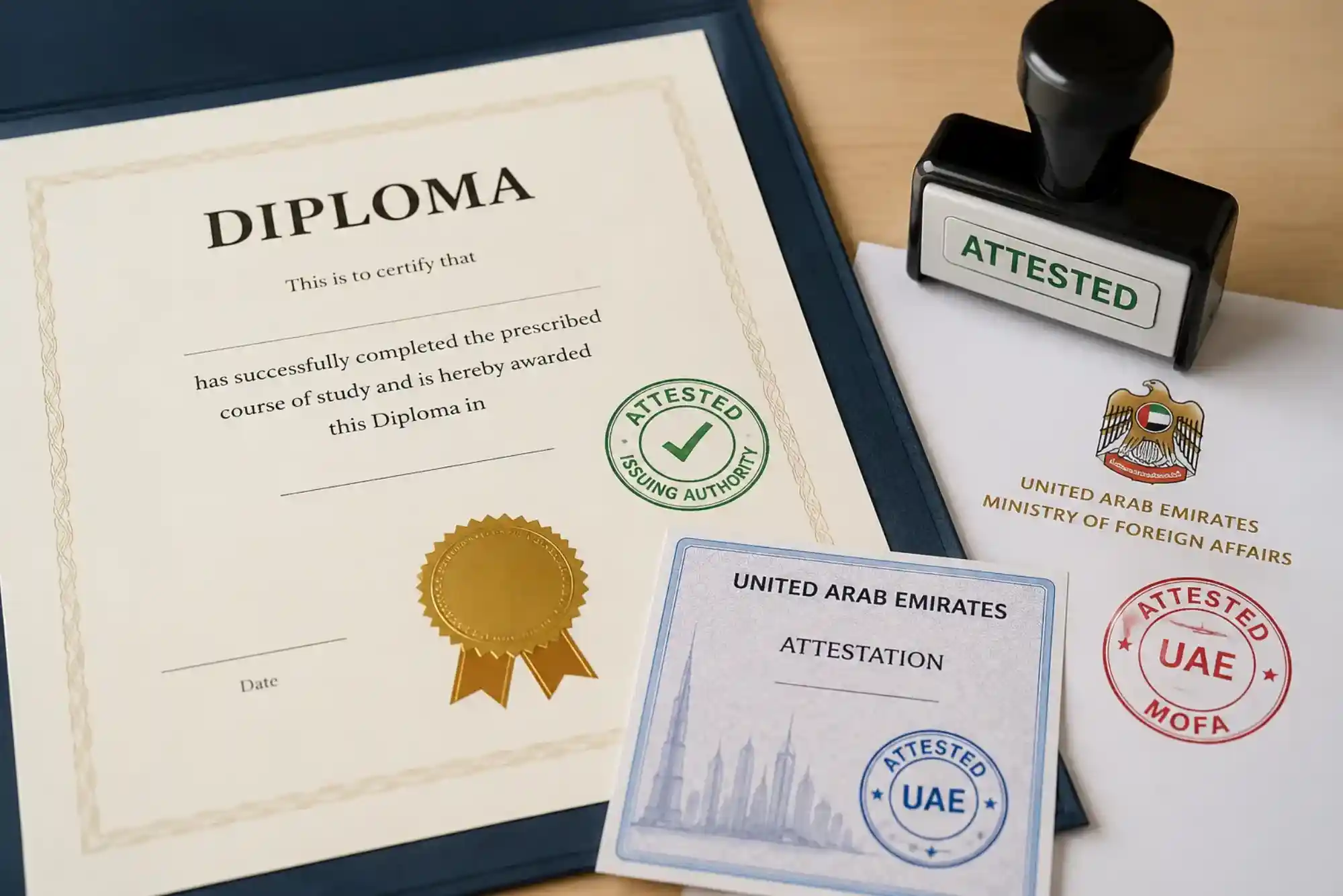
Introduction
When you plan to work, study, marry, sponsor family, or complete another official process in the UAE, your Philippine documents may need proper authentication before they can be accepted. Understanding how to attest documents from UAE Embassy in Philippines helps you avoid rejected applications, unnecessary trips, and delays.
Document attestation is essentially a verification process. It confirms that the signatures, seals, or certifications appearing on a document are genuine. Depending on the document, several authorities may be involved before the UAE Embassy in Manila completes its part of the process.
For example, a Philippine birth certificate, marriage certificate, diploma, transcript, or other official document may first need authentication through the appropriate Philippine authority. The UAE Embassy in Manila specifically states that documents submitted for authentication must bear the DFA Apostille. The exact requirements can vary according to the document type and intended use.
This guide explains how to attest documents from UAE Embassy in Philippines, including the basic formula, practical examples, preparation requirements, common mistakes, and useful tips.
What Does UAE Embassy Document Attestation Mean?
UAE Embassy document attestation is the process of authenticating a document so that it can be used for official purposes in the UAE. The process helps the receiving authority verify that the document was genuinely issued and properly authenticated.
The UAE Ministry of Foreign Affairs describes attestation as confirmation of the authenticity of signatures and seals on documents issued inside or outside the UAE.

For Philippine documents, the process generally involves authentication on the Philippine side before the document reaches the UAE Embassy in Manila. This is important because the embassy is not simply verifying an ordinary photocopy. It is checking a document that has already gone through the required authentication chain.
The most useful way to understand the process is through a simple formula:
Document Attestation = Original Document + Philippine Authentication + UAE Embassy Attestation + UAE-Side Requirements
The exact sequence can depend on the document and its issuing authority, so applicants should verify the current requirements before submitting anything.
Why Is Document Attestation Required for the UAE?
A document issued in the Philippines may not automatically be accepted as proof of an official fact in the UAE. Government departments, employers, educational institutions, immigration authorities, and other organizations often need assurance that the document is authentic.
Attestation creates a chain of verification between the issuing country and the country where the document will be used.
For example, imagine that a Philippine university issues a diploma. The UAE authority receiving that diploma needs confidence that it is an authentic document from that university. Authentication helps establish that connection.
This is especially important for educational certificates, civil-status documents, medical documents, employment-related papers, powers of attorney, and other official records.
If you need professional help understanding the legal side of document authentication, resources such as Lawyer in Dubai can also help you identify the appropriate legal service for your situation.
How to Attest Documents From UAE Embassy in Philippines
The first step is to identify exactly what type of document you have. A diploma, birth certificate, marriage certificate, transcript, and commercial document may follow different requirements.
Once you know the document type, check whether the original document is acceptable and whether it requires certification or authentication from the Philippine authorities before UAE Embassy submission.
The next stage is Philippine authentication. The UAE Embassy in Manila states that documents presented for authentication must bear the DFA Apostille. This means applicants should not assume that simply obtaining a document from a Philippine government office is enough.
After the required Philippine authentication has been completed, the document can proceed through the UAE Embassy’s applicable attestation process.
The UAE Ministry of Foreign Affairs provides an online document-attestation service and explains that documents issued outside the UAE can be submitted through UAE Missions abroad where the service is available.
Because procedures can change, applicants should confirm the current submission channel, courier requirements, fees, and appointment arrangements directly with the UAE Embassy in Manila before sending original documents.
Understanding the Attestation Formula
A simple formula makes the process easier to remember:
Obtain the Original Document
Start with the authentic document issued by the relevant Philippine authority, university, court, government office, or other authorized organization.
Complete Required Philippine Authentication
The document must go through the appropriate Philippine authentication process. For many documents intended for UAE use, this includes DFA Apostille requirements.
Submit for UAE Embassy Attestation
Once the document has the required Philippine authentication, submit it according to the UAE Embassy in Manila’s current procedure.
Complete UAE-Side Requirements
Depending on the purpose of the document, additional UAE procedures may be required after embassy attestation. For example, an employer, immigration authority, university, or other UAE organization may have additional requirements.
Therefore, the complete formula can be expressed as:
Original Document → Philippine Authentication → UAE Embassy Attestation → UAE Acceptance/Additional UAE Procedure
This formula is useful because it prevents a common mistake: assuming that embassy attestation is always the first step.
Attesting a Philippine Diploma
Suppose Maria has a bachelor’s degree from a Philippine university and wants to use her qualification for employment in the UAE.
Her first responsibility is to ensure that the diploma and any required academic records meet the authentication requirements. A transcript may be treated as a separate document from the diploma, so she should not automatically assume that attesting one document covers the other.
After obtaining the required certification or authentication from the relevant Philippine authorities, she can proceed with the UAE Embassy attestation process.
A simplified example is:
Diploma → Required Philippine Certification/Authentication → DFA Apostille → UAE Embassy Attestation → UAE Employer or Authority
The exact educational-document requirements can depend on the institution and document type. Philippine DFA guidance also identifies different requirements for documents from state and private educational institutions.
Attesting a Birth Certificate
Consider another applicant who needs a Philippine birth certificate for a UAE immigration or family-related procedure.
The applicant should obtain the appropriate original civil document and complete the required Philippine authentication process. The document then proceeds through the UAE Embassy’s applicable authentication route.
The important point is that a birth certificate should not be treated exactly like a diploma. Different issuing authorities and document categories can require different supporting procedures.
Before submission, check the document’s condition, authentication status, name spelling, and intended UAE purpose.
Attesting a Marriage Certificate
A Philippine marriage certificate may be needed for family sponsorship or another UAE administrative purpose.
The applicant should first ensure that the certificate is an acceptable official document and complete the required Philippine authentication. After the document meets the applicable authentication requirements, the UAE Embassy attestation can be processed.
If the names on the marriage certificate differ from the passport or other documents, resolve the discrepancy before beginning the attestation process whenever possible. A small spelling difference can create problems later, particularly when several documents are being submitted together.
Documents Commonly Associated With UAE Attestation
The UAE Ministry of Foreign Affairs identifies several categories of documents that can be subject to attestation, including educational certificates, transcripts, birth certificates, medical reports, marriage certificates, court documents, powers of attorney, employment documents, and other official records.
However, the fact that a document belongs to one of these categories does not automatically mean that it can be submitted without preliminary authentication.
The safest approach is to identify the issuing authority first, determine the required Philippine authentication, and then verify the UAE Embassy’s current submission procedure.
If you need broader information about authentication-related legal services, you can explore Notary & Attestation resources before preparing your documents.
How Long Does UAE Embassy Attestation Take?
The total time depends on the complete chain rather than just the embassy stage.
For a Philippine document, time may be required for obtaining or correcting the original document, completing Philippine authentication, arranging delivery or submission, processing the UAE Embassy attestation, and completing any additional UAE-side procedure.
This is why it is risky to promise a single universal processing time.
The UAE Ministry of Foreign Affairs currently states that processing outside the UAE through an approved service provider may take up to 15 business days, depending on the service provider. This does not necessarily represent the entire end-to-end timeline for a Philippine applicant because earlier Philippine authentication and later UAE requirements can add time.
If your document is needed for a job offer, visa process, university admission, or family sponsorship, start early rather than waiting until the deadline is close.
What Are the Main Requirements?
The most important requirement is usually the original document or an eligible official document that satisfies the applicable authentication rules.
The UAE Ministry of Foreign Affairs states that documents submitted through its attestation service generally need to be in Arabic or English, or accompanied by an official translation where required. It also states that documents must not be laminated.
For Philippine documents, the UAE Embassy in Manila specifically advises that documents for authentication must bear the DFA Apostille.
Applicants should also make sure that names, dates, signatures, seals, and other important information are consistent across related documents.
For example, if your passport says “Juan Dela Cruz” but your certificate says “Juan De La Cruz,” do not ignore the difference. Determine whether correction, supporting documentation, or another procedure is necessary before submitting the document.
Common Mistakes to Avoid
One common mistake is submitting a photocopy when the procedure requires an original document. Another is attempting embassy attestation before completing the required Philippine authentication.
Lamination is another issue worth checking. UAE MOFA guidance states that documents submitted for attestation should not be laminated.
Applicants also sometimes select the wrong document category or provide incorrect information during an online application. The UAE Ministry of Foreign Affairs warns that incorrect information can result in rejection.
Another avoidable problem is waiting until the last minute. Attestation involves multiple stages, and a problem discovered at one stage can affect the entire schedule.
Finally, do not rely on an old checklist without confirming current requirements. Embassy procedures, courier arrangements, fees, and submission methods can change.
Tips for a Smoother Attestation Process
Before starting, make a clear plan based on the document’s purpose. If you are attesting a diploma for employment, confirm what your employer or UAE authority actually requires. If you are preparing a marriage or birth certificate for family-related purposes, confirm the receiving authority’s requirements.
Keep your original documents secure throughout the process.
Check every name and date carefully before submission.
Keep digital scans or photocopies of your documents for your records, even when originals are required for processing.
Do not laminate documents before attestation.
Use official UAE and Philippine government information to verify the latest procedure instead of relying only on old social-media posts or informal advice.
Most importantly, do not assume that every Philippine document follows exactly the same route. The issuing authority and document type can change the authentication requirements.
Can a Lawyer Help With Document Attestation?
A lawyer or professional document-attestation service may be useful when the process involves complicated documents, name discrepancies, powers of attorney, legal instruments, or uncertainty about the correct authentication route.
Professional assistance can also be helpful when several documents need to be coordinated for one UAE application.
However, legal assistance does not replace the requirements of the issuing authority, Philippine DFA, UAE Embassy, or UAE government department. The document still needs to satisfy the applicable official requirements.
For general legal and attestation information, toplawyer can be another resource to explore.
What Happens After UAE Embassy Attestation?
Embassy attestation is not necessarily the final step for every document.
The organization receiving the document in the UAE may request additional verification, translation, registration, or another government procedure depending on why the document is being used.
For example, an employer may have specific requirements for an educational qualification. A family sponsorship application may have different requirements for a marriage or birth certificate.
Therefore, always ask the receiving UAE authority what it needs after embassy attestation. This prevents the common situation where a person completes attestation but later discovers that another step is required.
Learning how to attest documents from UAE Embassy in Philippines becomes much easier when the process is viewed as a chain rather than a single stamp.
Start with the correct original document, complete the required Philippine authentication, obtain the necessary DFA Apostille where applicable, follow the UAE Embassy in Manila’s current attestation procedure, and then check whether the receiving UAE authority requires anything further.
The most important tip is to verify the current requirements before submitting original documents. Small mistakes involving document type, authentication, names, translations, or submission methods can cause unnecessary delays.
FAQs
How do I attest a Philippine document for use in the UAE?
Start by obtaining the appropriate original Philippine document and completing the required Philippine authentication process. The UAE Embassy in Manila states that documents submitted for authentication must bear the DFA Apostille. After that, follow the embassy’s current submission procedure for UAE attestation.
Is DFA Apostille required for UAE Embassy attestation in the Philippines?
The UAE Embassy in Manila currently states that documents submitted for authentication must bear the DFA Apostille. Applicants should still confirm the current requirement for their particular document before submission.
Can I attest a diploma at the UAE Embassy in Manila?
Yes, educational documents can be subject to UAE attestation. However, the diploma may need certification and authentication through the appropriate Philippine authorities before UAE Embassy submission. A transcript may also be treated as a separate document.
How long does UAE document attestation take in the Philippines?
There is no single timeline for every applicant because the complete process can involve several authorities. UAE MOFA currently indicates that processing outside the UAE through an approved service provider may take up to 15 business days, depending on the provider. Philippine authentication and other steps can add additional time.
Can I submit a laminated document for UAE attestation?
UAE Ministry of Foreign Affairs guidance states that documents submitted for attestation should not be laminated. If your document is laminated, verify the appropriate procedure before submitting it.
Do I need the original document for attestation?
The applicable process generally requires an original document or an eligible official document. Requirements vary according to document type and attestation route, so confirm the current requirements before submission.
Can someone else process my UAE document attestation?
In some circumstances, an authorized representative or approved service provider may be able to assist with submission or delivery. The exact rules depend on the relevant authority and service channel, so applicants should verify authorization requirements before sending documents.
What should I do if my name is different on my documents?
Do not ignore the discrepancy. Compare the spelling across your passport, certificate, and other supporting documents and determine whether correction or additional evidence is required before attestation. Resolving inconsistencies early can prevent problems during later UAE procedures.