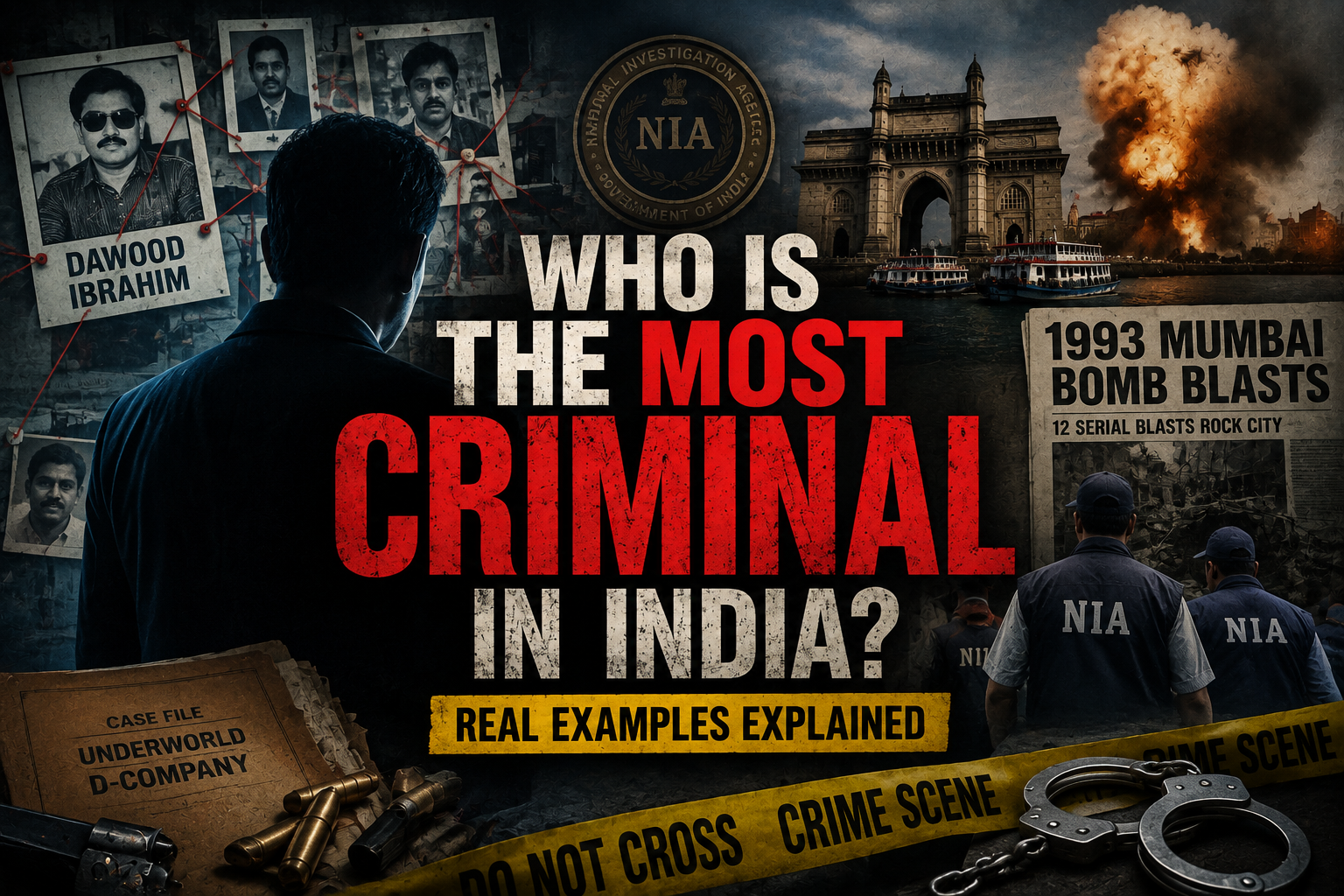
Meta Title: Who Is the Most Criminal in India? Real Examples Explained
Meta Description: Who is the most criminal in India? Explore the meaning of notorious criminals, Dawood Ibrahim and other major real-world cases, India’s crime data, convictions, terrorism laws, and legal context.
Who Is the Most Criminal in India? Explained With Real Examples
The question “Who is the most criminal in India?” sounds simple, but answering it accurately requires much more than naming one person. India has experienced many forms of serious crime, including organized crime, terrorism, murder, kidnapping, financial crime, trafficking, corruption, cybercrime, and crimes committed by organized criminal networks. Some individuals became notorious because of the scale of their alleged or proven activities, while others became historically significant because of particular criminal cases.
There is also an important legal distinction between being accused of a crime, being wanted by law-enforcement authorities, being convicted by a court, and being officially designated as a terrorist. These categories should never be treated as identical.
One of the most frequently cited names when discussing India’s most notorious criminal figures is Dawood Ibrahim Kaskar, who has been officially designated as a terrorist by the Government of India under the Unlawful Activities (Prevention) Act. India’s Ministry of Home Affairs lists Dawood Ibrahim among individuals designated under the UAPA, while the National Investigation Agency has described him as the head of an international terrorist network associated with D-Company.
However, saying that one individual is objectively “the most criminal person in India” would be misleading. There is no official Indian government ranking called “India’s most criminal person.” Crime is measured through offences, cases, investigations, convictions, victims, criminal organizations, and other legal categories rather than through a single national ranking of individuals.

This article examines the question in that broader context. It explains why Dawood Ibrahim is frequently mentioned in discussions of India’s most notorious criminals, looks at other important examples from India’s criminal history, explains the difference between accusations and convictions, and considers what current crime statistics tell us about crime in India today.
What Does “Most Criminal” Actually Mean?
Before identifying any notorious criminal figure, it is necessary to define the phrase itself.
“Most criminal” is not a formal legal category. Courts do not normally decide that somebody is “the most criminal person” in a country. Criminal law focuses on specific offences and the evidence connected to those offences.
A person might be considered notorious because of the number of crimes attributed to them. Another might be remembered because of the seriousness of one particular offence. Someone else might become internationally known because they allegedly controlled a major criminal organization.
These are very different measurements.
For example, organized crime leaders may be associated with extortion, smuggling, money laundering, weapons trafficking and violence over many years. A terrorist may be associated with attacks that caused mass casualties. A murderer may become infamous because of an exceptionally shocking case involving one or several victims. A financial criminal may cause enormous economic losses without committing the type of physical violence normally associated with organized crime.
Consequently, there is no scientifically or legally sound method for creating a single ranking of “the worst criminal in India.”
A better question is: Which individuals have been among the most notorious or significant criminal figures connected with India, based on documented investigations, court proceedings, government designations and historical records?
That question can be answered much more responsibly.
Dawood Ibrahim: Why His Name Is So Frequently Mentioned
When people search for India’s most notorious criminals, Dawood Ibrahim is one of the names that appears most often.
His significance is not simply based on popular culture or media descriptions. The Indian government has formally designated Dawood Ibrahim as a terrorist under the UAPA. The Ministry of Home Affairs’ official list identifies him as Dawood Ibrahim Kaskar, while the government’s designation materials state that he was involved with an international underworld crime syndicate and acts of terrorism.
The National Investigation Agency has also identified him as a fugitive terrorist and described D-Company as an international terrorist network. In an NIA notice concerning a terrorism case, the agency stated that Dawood Ibrahim was designated as a global terrorist by the United Nations and listed under the Fourth Schedule of the UAPA.
This official status makes Dawood Ibrahim substantially different from someone who is merely described by newspapers or social media as a “criminal.”
His name has been connected with the broader phenomenon of Mumbai’s underworld and the development of organized criminal networks with international links. His story has also been discussed extensively in journalism, books, documentaries and popular culture.
Yet even here, careful language matters. A government designation, an allegation in an investigation and a criminal conviction are separate legal concepts. Readers should not assume that every allegation associated with a person has automatically become a final judicial finding.
The Rise of Organized Crime in Mumbai
To understand why Dawood Ibrahim became such a significant figure, it helps to understand the history of organized crime in Mumbai.
Mumbai’s enormous population, international commercial connections, port infrastructure and expanding economy created opportunities for both legitimate commerce and illicit activity. During different periods, criminal networks became involved in smuggling, extortion, illegal gambling, narcotics and other activities.
The city’s underworld was not controlled by one person throughout its history. Different gangs and leaders emerged at different times, and alliances and rivalries changed.
Dawood Ibrahim became one of the most internationally recognized figures associated with this environment.
The significance of organized crime is that it differs from an individual committing a crime independently. Organized criminal networks can have structures, financial systems, intermediaries, international connections and methods for concealing illegal proceeds.
This is why law enforcement agencies often investigate criminal organizations rather than focusing exclusively on one individual.
The 1993 Mumbai Bombings and Dawood Ibrahim
The 1993 Mumbai bombings are among the most consequential events associated with India’s modern history of terrorism and organized crime.
The attacks involved a series of coordinated explosions across Mumbai. They caused large numbers of deaths and injuries and had a profound effect on India’s approach to terrorism, organized crime and national security.
Dawood Ibrahim has long been associated by Indian authorities with the conspiracy surrounding the attacks. Government records and investigative material have repeatedly connected his network with terrorism-related activities.
The Government of India’s 2019 designation specifically stated that Dawood Ibrahim runs an international underworld crime syndicate and is involved in terrorist activity.
The 1993 attacks also demonstrate why it can be misleading to describe a notorious criminal merely as a “gangster.” When organized crime networks become connected with terrorism, weapons, financing and international operations, the legal and national-security consequences become substantially more serious.
D-Company and the Concept of a Criminal Network
D-Company is frequently described as an organized criminal and terrorist network associated with Dawood Ibrahim.
The NIA has described the network as being involved in activities including arms smuggling, narcotics-related terrorism, money laundering, circulation of counterfeit currency and raising funds for terrorism. The agency has also described cooperation between the network and other designated terrorist organizations.
This is important because it illustrates a fundamental feature of modern organized crime: the individual at the top of a network may not personally carry out every illegal act.
Instead, networks can involve multiple participants performing different roles.
Some may handle finances. Others may arrange transportation. Some may recruit people or communicate with associates. Others may facilitate illegal transactions.
This structure makes organized crime particularly difficult for law enforcement because investigators have to establish relationships, financial flows, communications and individual responsibility.
Is Dawood Ibrahim “India’s Most Wanted Criminal”?
The phrase “most wanted” is often used by media organizations, but it should not be confused with an official ranking of criminality.
Dawood Ibrahim has been one of India’s most prominent fugitive criminal and terrorism-related figures for decades. The NIA has publicly identified him in connection with a terrorism case and announced a monetary reward for information leading to his apprehension.
The National Investigation Agency also maintains an official most-wanted section containing individuals sought in connection with different cases.
This shows why “most wanted,” “most notorious” and “most criminal” should not be treated as interchangeable terms.
A person may be highly wanted because of the seriousness of a particular case. Another person might have already been convicted and imprisoned, making them no longer a fugitive. A third might be notorious historically but no longer subject to active proceedings.
Other Notorious Criminal Figures in India’s History
Dawood Ibrahim is not the only name associated with India’s history of serious crime.
India has had notorious figures associated with organized crime, terrorism, kidnapping, murder and other offences. Some became famous through long-running criminal investigations, while others became known because of a single extraordinary case.
However, each case must be discussed according to its legal record.
A person who has been convicted by a court can appropriately be described as convicted of the relevant offence. A person who was accused but acquitted should not be described as guilty of that offence. Similarly, a person who remains an accused should be described as an accused rather than automatically as a criminal.
This distinction is particularly important when writing about living people.
The Case of Charles Sobhraj
Charles Sobhraj became internationally notorious for crimes committed across several countries, including India.
His story is unusual because his criminal activities extended beyond one jurisdiction. He was associated with deception, theft and murder allegations involving travelers across Asia during the 1970s.
He was imprisoned in India for a period after being convicted in connection with criminal activity there. His story later became the subject of books, television productions and documentaries.
Sobhraj demonstrates another problem with the phrase “most criminal in India.” A criminal figure can become famous in India even when their criminal activity is international rather than limited to Indian territory.
His case also illustrates how difficult cross-border criminal investigations can be. When victims, suspects, evidence and witnesses are spread across multiple countries, investigations require cooperation between law-enforcement authorities.
Veerappan and Organized Crime in Southern India
Veerappan became one of India’s most notorious criminal figures through activities involving sandalwood smuggling, poaching, kidnapping and violence.
Operating primarily in forested areas across parts of southern India, he became a major challenge for law enforcement. His knowledge of the terrain and ability to operate in difficult environments made his capture extremely difficult.
His case demonstrates a different type of criminal organization from the urban underworld associated with Mumbai.
Instead of relying primarily on an urban network, Veerappan operated through knowledge of remote forests and local geography. The illegal sandalwood trade became a major source of his criminal activities.
His story is often discussed as an example of how geography can influence organized crime.
The Bandit Tradition and Phoolan Devi
Phoolan Devi is another complicated figure in discussions of India’s criminal history.
She became widely known as a bandit and was associated with the infamous Behmai massacre. Later, she entered politics and became a Member of Parliament.
Her story is particularly complicated because it combines criminal allegations, violence, caste and gender issues, victimization, political transformation and public mythology.
That complexity demonstrates why historical criminal figures should not always be reduced to simple labels.
Someone can have been accused or convicted of serious offences while also having a personal history that is relevant to understanding why they entered a particular environment.
Understanding those circumstances does not excuse crimes. It provides context.
Why Criminal Statistics Are More Useful Than a “Worst Criminal” Ranking
If the goal is to understand crime in India, individual criminal celebrities provide only a small part of the picture.
The National Crime Records Bureau compiles India’s official annual crime statistics. The latest published Crime in India report is for 2023, according to the Ministry of Home Affairs. The 2023 dataset covers a wide range of categories, including violent crime, murder, crimes against women and children, property crime, cybercrime, arrests and court-related outcomes.
These statistics provide a much more useful way of understanding crime because they show patterns across states, cities and crime categories.
They also reveal that crime is not simply about famous gangsters.
A country can experience significant crime without having one dominant criminal figure. Crime can be distributed across thousands of unrelated offenders and numerous categories.
What the 2023 Crime Data Tells Us
The NCRB’s 2023 Crime in India data contains information on cognizable crimes, violent offences, murder, kidnapping, crimes against women and children, property offences, cybercrime and numerous other categories.
According to reporting based on the NCRB’s 2023 report, India recorded 27,721 murder cases in 2023, while reported cybercrime cases increased substantially compared with the previous year.
These figures provide an important lesson.
The criminal threat facing India today cannot be understood simply by looking at famous underworld figures from previous decades. Crime has evolved.
Cyber fraud, identity theft, online financial scams, digital extortion and other technology-enabled offences have become increasingly important.
The Indian government has also highlighted the expansion of cybercrime investigation capabilities, including digital forensic infrastructure.
Cybercrime Is Changing the Meaning of “Serious Criminal”
In the past, the public image of a dangerous criminal was often associated with a gangster carrying a weapon or controlling a street-level network.
Modern crime can look very different.
A cybercriminal may operate from another city or country. They may never meet their victims personally. They can use social engineering, malicious software, stolen credentials, fake websites or financial deception to target large numbers of people.
A single organized cybercrime operation can potentially affect victims across several regions.
This is one reason that current crime analysis must go beyond traditional violent crime.
The Ministry of Home Affairs has stated that the latest published NCRB Crime in India report is for 2023 and that police and public order are primarily state subjects under India’s constitutional framework.
That means crime prevention and investigation involve both state-level police organizations and central agencies where appropriate.
Why Being Accused Does Not Mean Being Guilty
One of the most important principles when discussing criminal cases is the difference between an accusation and a conviction.
When police investigate someone, that does not automatically establish guilt. An investigation can lead to an arrest, charges and a prosecution, but the court ultimately evaluates the evidence according to the applicable law.
This is why responsible articles should use terms such as “accused,” “suspect,” “wanted,” “convicted” or “designated terrorist” accurately.
These terms have different meanings.
Calling every accused person a criminal can create a false impression about the legal status of a case.
The distinction is especially important when writing about contemporary public figures or people whose cases remain pending.
Conviction Is Different From Reputation
Public reputation can develop independently of a legal case.
A person may be widely portrayed as a criminal in newspapers, films or online discussions, but reputation does not replace judicial findings.
Conversely, a person may have been convicted of a crime without becoming internationally famous.
This is why the question “Who is the most criminal in India?” cannot be answered simply by searching for the person with the most media coverage.
Media attention and criminal responsibility are not the same thing.
A responsible analysis should prioritize official records and judicial findings.
The Role of India’s Criminal Law System
India’s criminal justice system involves investigation, prosecution, courts and correctional institutions.
Police investigate suspected offences and gather evidence. Prosecutors present cases in court. Judges evaluate the evidence and apply the law.
For people dealing with criminal allegations, understanding the relevant criminal-law process can be important because the consequences of an accusation can be serious even before a final judgment.
Readers seeking general information about criminal-law concepts can also explore this criminal law resource.
The practical lesson is simple: criminal cases should be evaluated through legal procedures rather than through social-media claims.
Why India Does Not Have an Official “Most Criminal Person” List
There are government lists containing particular categories of individuals, including people designated as terrorists under specific laws and people wanted in specific investigations.
But these should not be confused with a nationwide ranking of the “most criminal people.”
For example, the Ministry of Home Affairs publishes a list of individuals designated as terrorists under the UAPA. Dawood Ibrahim appears on that official list.
That designation has a specific statutory meaning.
It does not create a universal ranking of every criminal in India.
Similarly, the NIA’s most-wanted pages concern people wanted in particular investigations.
The difference is important for anyone researching the topic online.
What Makes an Organized Criminal Network Dangerous?
Organized crime becomes especially dangerous when it combines several capabilities.
A network may have money, weapons, corrupt contacts, transportation systems, communication channels and international connections.
Money is particularly important.
Illegal profits can be reinvested into the criminal organization. They can finance recruitment, logistics and further illegal activity.
Money laundering allows criminal proceeds to be moved or disguised through financial transactions and assets.
This is one reason modern criminal investigations often involve financial intelligence alongside traditional police investigation.
The Connection Between Organized Crime and Terrorism
Organized crime and terrorism are distinct concepts, but they can overlap.
A criminal network may seek profit, while a terrorist organization generally seeks political, ideological or religious objectives. However, criminal activities can sometimes provide funding or logistical support for terrorism.
The Indian government’s treatment of Dawood Ibrahim illustrates how authorities can regard an individual as having both organized-crime and terrorism-related significance.
The Ministry of Home Affairs states that Dawood Ibrahim was designated as a terrorist under the UAPA, and the NIA has described D-Company in terms of terrorism and organized criminal activity.
This overlap makes such cases especially complex.
Why Real Examples Matter
Real examples help readers understand that “crime” is not one single phenomenon.
Dawood Ibrahim represents the intersection of organized crime, international networks and terrorism-related allegations and designations.
Veerappan represents organized criminal activity connected to smuggling, poaching, kidnapping and remote geography.
Charles Sobhraj represents international criminality and cross-border investigations.
Modern cybercriminal networks demonstrate how technology has changed criminal opportunities.
Each example involves different methods, victims, investigative challenges and legal issues.
Therefore, trying to identify one person as the “most criminal” hides the complexity of the subject.
How Criminal Investigations Establish Responsibility
A criminal investigation generally seeks evidence capable of connecting a suspect with a particular offence.
Depending on the case, investigators may examine physical evidence, documents, financial transactions, communications, witness testimony, surveillance material, forensic evidence and digital records.
The exact evidence required varies according to the alleged offence.
In organized crime cases, investigators may also attempt to identify relationships between individuals and establish the structure of a criminal network.
This is often much more complicated than proving a single isolated offence.
Why Evidence Matters More Than Online Claims
The internet contains enormous amounts of information about famous criminals.
Some of it comes from reputable sources. Some comes from documentaries or historical research. Some comes from anonymous social-media accounts.
These sources should not be treated equally.
A government notification, court judgment, official investigation document or verified statistical dataset generally provides stronger evidence than an unsourced social-media post.
This is especially important for sensitive accusations involving living individuals.
A responsible writer should never manufacture criminal allegations merely to make an article more dramatic.
The Difference Between Crime Rate and Number of Crimes
Another common misunderstanding is treating the number of registered cases as an exact measure of how criminal a state or city is.
Crime statistics have to be interpreted carefully.
A state with a large population may naturally record more cases than a smaller state. Reporting practices can also differ. Police registration policies, public willingness to report offences, awareness of legal rights and administrative practices can influence recorded figures.
The NCRB’s own datasets caution that states and union territories should not necessarily be compared purely on the basis of crime figures.
This is an important limitation.
A higher number of registered cases does not automatically mean that every resident in that area faces a higher risk of crime.
The Importance of Crime Reporting
Official statistics measure reported and registered crime, not every crime that occurs.
Some offences may never be reported to authorities.
Victims may fear retaliation, social stigma, financial consequences or other pressures.
This is particularly relevant in crimes involving family members, sexual violence, financial fraud or vulnerable victims.
Consequently, crime statistics should be interpreted as an important source of evidence rather than a perfect measurement of every criminal act.
Why the Most Famous Criminal Is Not Necessarily the Most Dangerous
Fame and danger are not identical.
A criminal may receive enormous media attention because the case is sensational. Another offender may quietly conduct financial fraud against thousands of people but receive far less public attention.
A famous gangster can therefore dominate public perception even when a completely different category of crime causes broader economic or social harm.
This is why modern crime analysis should combine individual case studies with national statistics.
What Can Readers Learn From These Cases?
The most important lesson is that criminality changes over time.
In one period, smuggling and organized street crime may dominate public attention.
In another, terrorism may become the major security concern.
Today, cybercrime and technology-enabled financial fraud have become increasingly important alongside traditional offences.
Law enforcement has had to adapt accordingly.
India has developed specialized agencies and forensic capabilities for complex crimes, including cybercrime. The government has reported the operation of central and state forensic laboratories supporting investigations.
This demonstrates that criminal justice is not static.
Criminal Law and the Need for Professional Advice
When someone becomes involved in an actual criminal case, online articles are not a substitute for professional legal advice.
The correct legal strategy depends on the specific facts, applicable legislation, procedural stage and available evidence.
A person facing an accusation should understand the difference between an arrest, investigation, charge, prosecution and conviction.
Someone seeking legal assistance in a particular jurisdiction should also verify that the lawyer is properly qualified and able to advise on the relevant law.
For readers looking for legal services outside India, including Abu Dhabi-related legal matters, this Abu Dhabi lawyers resource provides a separate location-specific starting point. It should not be interpreted as an Indian legal resource.
Why Sensational Labels Can Be Misleading
Terms such as “India’s biggest criminal,” “India’s most dangerous gangster” or “the world’s worst criminal” attract attention because they are emotionally powerful.
But they often simplify complicated cases.
A person may be notorious for one particular type of crime while another may be responsible for a much broader criminal network.
The legal system does not determine guilt through popularity contests.
It relies on evidence, law and judicial procedure.
For SEO content, sensational titles can attract clicks, but high-quality content should satisfy the reader once they arrive. That means answering the underlying question accurately rather than exaggerating claims.
A More Accurate Answer to the Question
So, who is the most criminal in India?
There is no official or objective answer.
If the question refers to one of the most notorious organized-crime and terrorism-related figures associated with India, Dawood Ibrahim is among the most significant names, and his status is supported by official government records rather than merely media reputation. The Government of India has designated him as a terrorist under the UAPA, and the NIA has described his network as an international terrorist network connected with serious criminal activities.
But it would be inaccurate to state that he is officially “the most criminal person in India,” because no such government ranking exists.
Other notorious figures, including Veerappan and Charles Sobhraj, became significant for very different reasons. Historical criminal cases also involve many people whose names may be less famous but whose offences were extremely serious.
The better conclusion is therefore that India has had numerous notorious criminal figures rather than one officially recognized “most criminal” person.
Frequently Asked Questions
Who is considered the most notorious criminal in India?
Dawood Ibrahim is widely regarded as one of the most notorious criminal figures associated with India. His significance is reinforced by his official designation as a terrorist by the Government of India under the UAPA and by NIA material describing his connection with D-Company.
However, India has no official ranking that declares one person to be the country’s “most criminal.”
Is Dawood Ibrahim officially designated as a terrorist?
Yes. India’s Ministry of Home Affairs lists Dawood Ibrahim Kaskar among individuals designated as terrorists under the UAPA.
Why is Dawood Ibrahim so famous?
His notoriety is connected to the development of the D-Company criminal network, organized crime, terrorism-related investigations and his long-standing status as a fugitive figure. Indian government and NIA documents have described his network in connection with serious criminal and terrorism-related activities.
Is “most criminal” a legal term in India?
No. “Most criminal” is not a formal legal classification. Indian law deals with specific offences, accused persons, convictions, designated terrorists, wanted individuals and other defined legal categories.
Who was Veerappan?
Veerappan was a notorious criminal figure associated with sandalwood smuggling, poaching, kidnapping and violence in southern India. His activities became a major law-enforcement challenge because of his ability to operate in forested terrain.
Is Charles Sobhraj an Indian criminal?
Charles Sobhraj was not simply an Indian criminal; he was an internationally notorious criminal figure associated with crimes across several Asian countries. He was also imprisoned in India following criminal proceedings there.
Does India have an official list of the worst criminals?
India has official lists for particular legal purposes, such as individuals designated as terrorists and people wanted in specific investigations. These are not equivalent to a universal ranking of the country’s “worst criminals.” The MHA’s terrorist-designation list and the NIA’s most-wanted database are examples of these more specific categories.
What is India’s latest official crime report?
As of 2026, the latest published NCRB Crime in India report is for 2023. The Government of India has confirmed that the NCRB compiles and publishes these crime statistics.
Does a criminal accusation prove guilt?
No. An accusation or arrest does not by itself establish guilt. Criminal responsibility must be determined through the applicable legal process and evidence.
Why is it dangerous to call someone a criminal without checking the legal record?
Because people can be accused without being convicted, and cases can be dismissed or result in acquittal. Accurate writing should distinguish between allegations, investigations, charges, convictions and official designations.
Conclusion
The search for “who is the most criminal in India” does not have a single official answer. India has experienced many forms of serious crime, and different individuals have become notorious for different reasons.
Dawood Ibrahim stands out as one of the most significant examples because his case involves organized crime, international networks and terrorism-related designations. The Government of India officially designated him as a terrorist under the UAPA, while the NIA has described D-Company and its associated activities in serious criminal and terrorism-related terms.
But his prominence should not be confused with an official title of “India’s most criminal person.” No such ranking exists.
The broader story of crime in India is much larger than any single gangster. Historical figures such as Veerappan and Charles Sobhraj illustrate different forms of serious criminal activity, while modern cybercrime demonstrates how rapidly criminal methods are changing. Current NCRB data covers a wide range of offences and provides a more meaningful picture of India’s criminal landscape than a list of famous names.
Ultimately, the most responsible way to understand criminal cases is to examine verified evidence, official records, court proceedings and reliable crime statistics. Real examples can make the subject easier to understand, but accuracy must come before sensationalism.
For anyone researching this topic for educational, legal or SEO purposes, the central lesson is clear: India does not have one officially recognized “most criminal” person; instead, it has a long and complex history involving many notorious individuals, criminal organizations and evolving forms of crime.