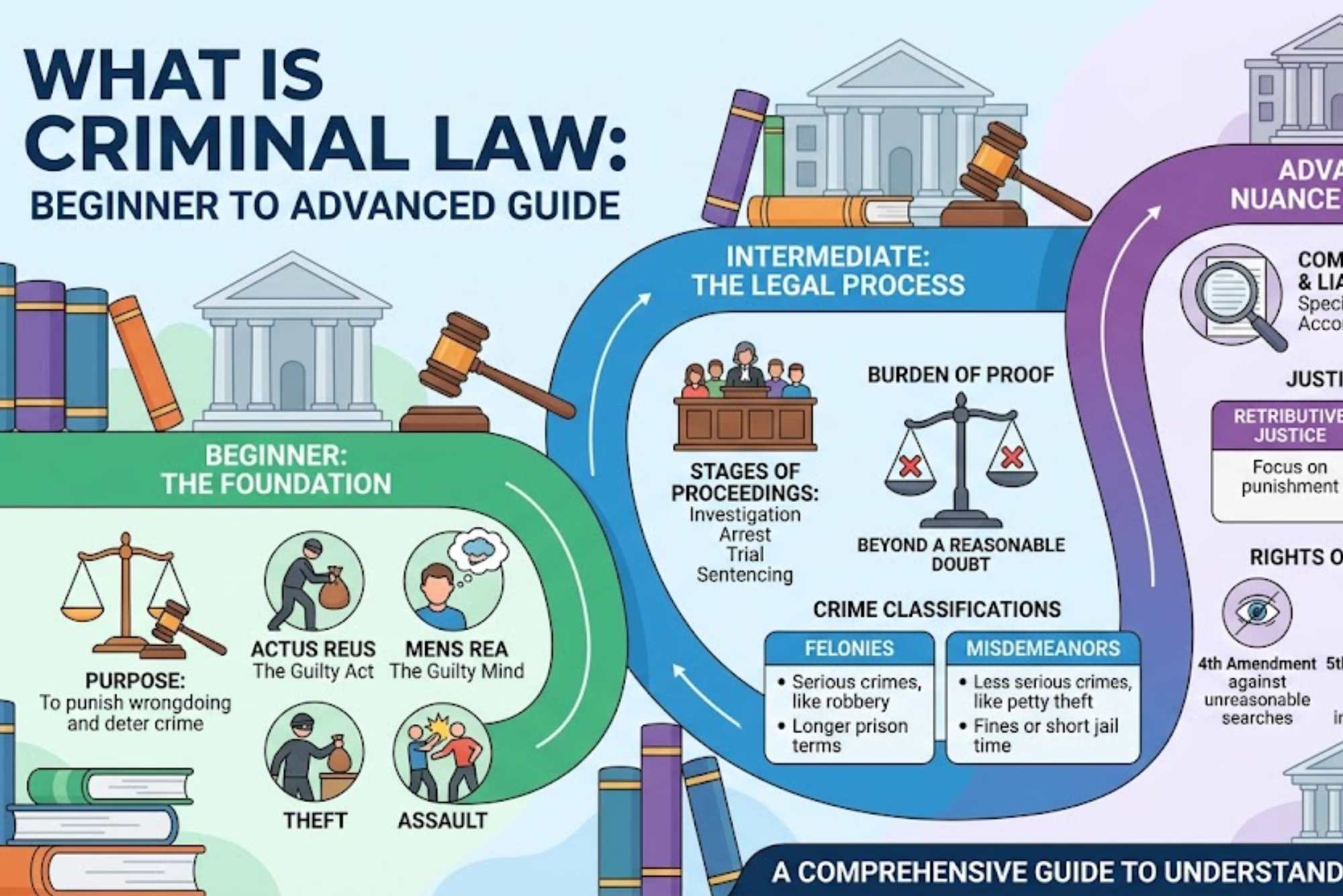
Introduction to Criminal Law
Criminal law is one of the most fundamental branches of the legal system, shaping how societies maintain order, punish wrongdoing, and protect public safety. From minor offenses to serious crimes, criminal law defines what behavior is considered unlawful and outlines the consequences for those who violate legal rules.
For students, legal professionals, and individuals seeking legal awareness, understanding criminal law is essential. It not only explains how justice is delivered but also highlights how rights, responsibilities, and fairness are balanced within a structured legal system.
What is Criminal Law?
Criminal law refers to a body of laws that deal with conduct considered harmful to society as a whole. Unlike civil law, which focuses on disputes between private individuals or organizations, criminal law involves offenses that are prosecuted by the state or government.
The core idea behind criminal law is accountability. When a person commits a crime, it is not just viewed as harm to an individual victim but as a violation of public order. As a result, the state takes legal action to investigate, prosecute, and, if necessary, punish the offender.
Criminal law covers a wide range of offenses, including theft, assault, fraud, drug-related crimes, and more serious offenses such as homicide. Each category carries different legal procedures and penalties based on the severity of the crime.
Core Objectives of Criminal Law
Criminal law serves several important purposes within society. These objectives help maintain stability, protect individuals, and ensure justice is fairly administered.

One of the primary objectives is maintaining public order. By clearly defining illegal behavior, criminal law discourages individuals from engaging in harmful actions that could disrupt social harmony.
Another key objective is punishment. Criminal law ensures that individuals who violate laws face appropriate consequences, which may include imprisonment, fines, or community service.
Criminal law also plays a preventive role. By enforcing penalties, it discourages others from committing similar offenses. This concept is known as deterrence and is a cornerstone of many modern justice systems.
Finally, criminal law focuses on rehabilitation. Many legal systems aim to reform offenders so they can reintegrate into society and avoid reoffending in the future.
Types of Criminal Law
Felonies and Misdemeanors
Criminal offenses are often categorized based on their severity. Felonies are serious crimes such as murder, robbery, or major fraud. These offenses typically carry severe penalties, including long-term imprisonment.
Misdemeanors, on the other hand, are less serious offenses. These may include petty theft, minor assault, or traffic violations. While they are still punishable by law, the consequences are generally less severe than felonies.
Violent and Non-Violent Crimes
Another common classification divides crimes into violent and non-violent categories. Violent crimes involve physical harm or the threat of harm to others, such as assault or homicide.
Non-violent crimes include offenses like fraud, embezzlement, cybercrime, or drug possession. Although these crimes may not involve physical violence, they can still have significant financial or social consequences.
Criminal Justice System Explained
The criminal justice system is the framework through which criminal law is enforced. It consists of multiple stages designed to ensure fairness, accuracy, and accountability in legal proceedings.
Law Enforcement Stage
The process typically begins with law enforcement agencies, such as police, investigating suspected criminal activity. Officers gather evidence, interview witnesses, and may arrest individuals based on probable cause.
Prosecution and Court Process
Once an arrest is made, the case is handed over to prosecutors. They evaluate the evidence and decide whether to file formal charges. If the case proceeds, it is presented in court, where both sides argue their positions before a judge or jury.
Sentencing and Corrections
If a defendant is found guilty, the court imposes a sentence. This may include imprisonment, fines, probation, or other corrective measures. The correctional system then oversees the execution of the sentence.
Criminal Procedure and Legal Rights
Criminal procedure refers to the rules and processes that govern how criminal cases are handled. These procedures ensure that investigations and trials are conducted fairly and lawfully.
One of the most important aspects of criminal procedure is the protection of individual rights. Accused persons are generally presumed innocent until proven guilty. They also have the right to legal representation, a fair trial, and protection against unlawful searches or arrests.
These rights are essential to maintaining trust in the justice system and preventing abuse of power.
Role of a Criminal Defense Lawyer
A criminal defense lawyer plays a critical role in representing individuals accused of crimes. Their responsibility is to ensure that the accused receives a fair trial and that their legal rights are protected throughout the process.
Defense lawyers analyze evidence, challenge prosecution arguments, negotiate plea deals, and present legal defenses in court. Their expertise is essential in ensuring that justice is balanced and not one-sided.
In many cases, the quality of legal representation can significantly influence the outcome of a case.
Real-World Examples of Criminal Law
Criminal law is applied in a wide range of real-world situations. For example, theft cases involve individuals unlawfully taking property belonging to others. These cases are investigated by law enforcement and prosecuted in court.
Another common example is fraud, where individuals or organizations intentionally deceive others for financial gain. Cybercrime is also increasingly relevant, involving hacking, identity theft, and online scams.
Serious crimes such as homicide or assault are treated with the highest level of legal scrutiny due to their impact on human life and safety. These cases often involve complex investigations and lengthy court proceedings.
Importance of Criminal Law in Society
Criminal law is essential for maintaining order and protecting citizens. Without it, societies would face increased levels of chaos, insecurity, and injustice.
It helps establish clear boundaries between acceptable and unacceptable behavior. It also ensures that individuals who cause harm are held accountable in a structured and fair manner.
Moreover, criminal law promotes public confidence in the justice system by ensuring that laws are applied consistently and fairly across all cases.
Challenges in Criminal Law Systems
Despite its importance, criminal law systems face several challenges. One major issue is ensuring equal access to justice, as not all individuals have the same legal resources or representation.
Another challenge is dealing with complex modern crimes such as cybercrime, which often cross international borders and require advanced investigative techniques.
Delays in court proceedings can also affect the efficiency of justice delivery, leading to backlogs and prolonged trials.
Additionally, balancing strict law enforcement with the protection of human rights remains an ongoing legal and ethical challenge.
Conclusion
Criminal law is a vital component of any functioning society. It defines what constitutes a crime, establishes penalties, and ensures that justice is delivered fairly and consistently.
From investigation to trial and sentencing, criminal law provides a structured process that protects both society and individual rights. Understanding its principles helps individuals become more aware of their legal responsibilities and protections.
Ultimately, criminal law serves as the foundation of public order, ensuring that justice, fairness, and accountability remain central to modern legal systems.