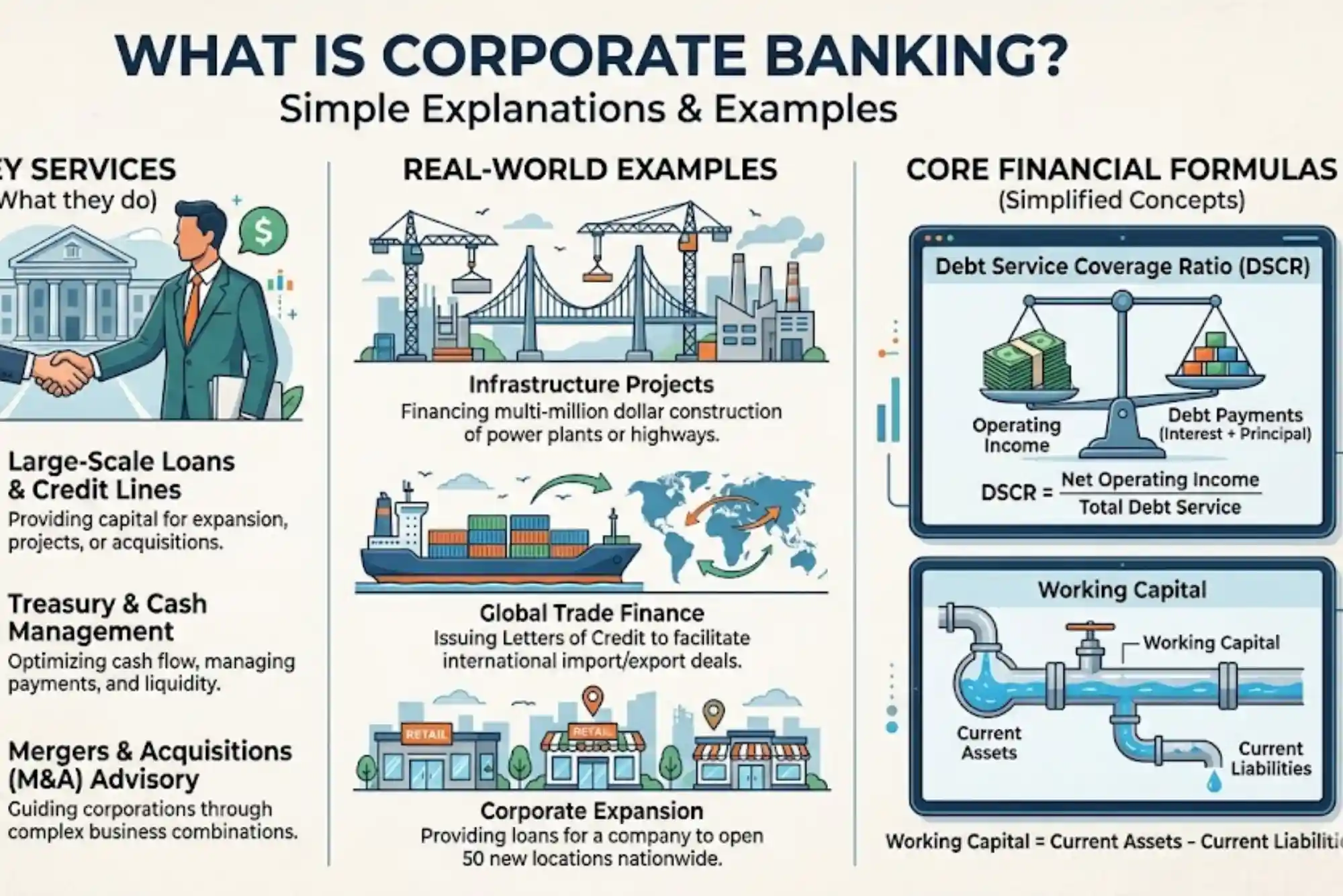
Corporate banking plays a central role in the global financial system, yet it often remains misunderstood outside professional circles. At its core, corporate banking refers to financial services specifically designed for businesses, ranging from small enterprises to multinational corporations. These services help companies manage cash flow, secure funding, and execute complex financial strategies.
Understanding corporate banking is not only useful for finance professionals but also essential for entrepreneurs, business owners, and decision-makers. In this guide, we break down the concept into simple explanations, introduce key formulas, and provide real-world examples to make the subject accessible and practical.
Understanding Corporate Banking
Corporate banking focuses on delivering tailored financial solutions to businesses rather than individuals. Unlike retail banking, which serves personal accounts and consumer loans, corporate banking deals with large-scale financial transactions, structured financing, and strategic advisory services.
Banks that operate in this space typically work closely with corporate clients to understand their operational needs. This relationship-driven approach ensures that financial products align with business goals, whether it involves expansion, risk management, or capital restructuring.
Key Services Offered in Corporate Banking
Business Lending and Credit Facilities
One of the primary functions of corporate banking is providing loans and credit facilities. These may include term loans, revolving credit lines, and project financing. Businesses rely on these services to fund operations, invest in infrastructure, or expand into new markets.
Cash Management Solutions
Efficient cash flow is vital for any organization. Corporate banks offer cash management services that allow companies to monitor inflows and outflows, optimize liquidity, and ensure timely payments.

Trade Finance
Trade finance supports businesses engaged in international trade. It includes instruments such as letters of credit and guarantees, which reduce risks associated with cross-border transactions.
Advisory and Risk Management
Corporate banks also provide advisory services, helping companies navigate complex financial landscapes. This includes managing currency risks, interest rate fluctuations, and regulatory compliance.
Simple Formulas Used in Corporate Banking
While corporate banking involves sophisticated financial models, several core formulas form the foundation of decision-making. Understanding these basic calculations can provide valuable insights into how businesses manage their finances.
Working Capital Formula
Working Capital = Current Assets − Current Liabilities
This formula measures a company’s ability to cover short-term obligations. A positive working capital indicates financial stability, while a negative figure may signal liquidity issues.
Debt-to-Equity Ratio
Debt-to-Equity Ratio = Total Liabilities ÷ Shareholder Equity
This ratio helps banks assess the financial leverage of a company. A higher ratio suggests greater reliance on borrowed funds, which may increase risk.
Interest Coverage Ratio
Interest Coverage Ratio = Earnings Before Interest and Taxes (EBIT) ÷ Interest Expense
This formula evaluates a company’s ability to meet interest payments. It is a critical metric for lenders when approving loans.
Real-World Examples of Corporate Banking
To better understand how corporate banking works, consider a manufacturing company seeking to expand its operations. The company approaches a bank for a loan to build a new production facility. After evaluating financial statements and risk factors, the bank provides a structured loan with specific repayment terms.
In another example, a multinational company engaged in international trade may use trade finance services to secure payments from overseas buyers. The bank acts as an intermediary, reducing the risk of non-payment and ensuring smooth transactions.
Corporate banking also plays a crucial role in mergers and acquisitions. When one company acquires another, banks provide advisory services and financing solutions to facilitate the transaction.
The Role of Corporate Banking in Business Growth
Corporate banking is more than just a financial service; it is a strategic partner in business growth. By providing access to capital, banks enable companies to invest in innovation, expand operations, and enter new markets.
Additionally, corporate banks help businesses manage risks effectively. Through hedging strategies and financial planning, companies can protect themselves from market volatility and economic uncertainties.
Legal Considerations in Corporate Banking
Corporate banking transactions often involve complex legal frameworks. From loan agreements to compliance regulations, businesses must ensure that all financial dealings adhere to applicable laws.
For companies operating in the UAE, consulting experienced legal professionals can be crucial. For instance, businesses may seek guidance from corporate legal experts in Abu Dhabi to navigate regulatory requirements and protect their interests.
Corporate Banking vs Investment Banking
Although often confused, corporate banking and investment banking serve different purposes. Corporate banking focuses on lending and financial services for businesses, while investment banking deals with capital markets, underwriting, and advisory services for large-scale financial transactions.
Both sectors may overlap in certain areas, but their core functions remain distinct. Understanding this difference helps businesses choose the right financial partner for their needs.
Challenges in Corporate Banking
Despite its importance, corporate banking faces several challenges. Economic fluctuations, regulatory changes, and technological disruptions can impact operations. Banks must continuously adapt to evolving market conditions while maintaining strong client relationships.
Digital transformation is another key challenge. As financial technology advances, corporate banks must integrate innovative solutions to remain competitive and meet client expectations.
Future Trends in Corporate Banking
The future of corporate banking is shaped by technology and globalization. Digital platforms, artificial intelligence, and data analytics are transforming how banks deliver services. These advancements enable faster transactions, improved risk assessment, and enhanced customer experiences.
Sustainability is also becoming a priority. Many corporate banks are now focusing on green financing and supporting environmentally responsible projects.
Conclusion
Corporate banking is a vital component of the modern financial ecosystem. It provides businesses with the tools and resources needed to grow, manage risks, and achieve long-term success. By understanding its core concepts, formulas, and real-world applications, individuals and organizations can make informed financial decisions.
Whether you are a business owner seeking funding or a professional exploring finance, corporate banking offers valuable opportunities and insights. As the industry continues to evolve, staying informed will be key to leveraging its full potential.