Questions about criminal history appear in job applications, visa forms, and legal documentation more often than many people expect. One of the most commonly misunderstood questions is: “Do you have any unspent criminal convictions?”
For many individuals, the uncertainty lies not in whether they have a record, but in whether that record still “counts.” Understanding the concept of unspent convictions is essential for making accurate disclosures, avoiding legal complications, and protecting your future opportunities.
This guide provides a clear, legally grounded explanation of what unspent convictions are, why they matter, and how to determine your status step by step.
What Does “Unspent Criminal Conviction” Mean?
An unspent criminal conviction refers to a conviction that still falls within its legally defined rehabilitation period. During this period, the conviction must typically be disclosed when requested in official contexts such as employment, immigration, or licensing.
The rules surrounding unspent convictions vary depending on jurisdiction, but the underlying principle remains consistent: certain convictions remain legally relevant for a specific period after sentencing.
Until that period ends, the conviction is considered “active” for disclosure purposes.

Spent vs Unspent Convictions Explained
What Makes a Conviction “Spent”?
A conviction becomes “spent” once the individual has completed a legally defined rehabilitation period without committing further offenses. Once spent, the individual may not be required to disclose the conviction in many situations, depending on applicable laws.
The idea behind this concept is rehabilitation. Legal systems recognize that individuals can reform, and after a certain period, past offenses should not indefinitely hinder future opportunities.
What Keeps a Conviction “Unspent”?
A conviction remains unspent if the rehabilitation period has not yet passed, or if the offense falls into a category that does not qualify for becoming spent. Serious offenses often carry longer or indefinite disclosure requirements.
Factors such as the severity of the offense, the type of sentence imposed, and whether additional offenses occurred can all influence this status.
Why Unspent Convictions Matter
Employment and Background Checks
Many employers conduct background checks as part of their hiring process. If a conviction is unspent, it may need to be disclosed when requested. Failure to do so can lead to job offer withdrawals or termination.
In regulated sectors such as finance, healthcare, or law, disclosure requirements are often stricter due to the sensitive nature of the roles.
Visa and Immigration Applications
Immigration authorities frequently ask about criminal history. Unspent convictions can affect visa approvals, residency applications, or travel permissions.
Providing accurate and complete information is essential, as discrepancies can lead to delays or rejections.
Professional Licensing and Compliance
Certain professions require licenses or certifications, and regulatory bodies may require disclosure of unspent convictions. This ensures that professionals meet ethical and legal standards expected within their field.
Step-by-Step Guide to Determining If You Have an Unspent Conviction
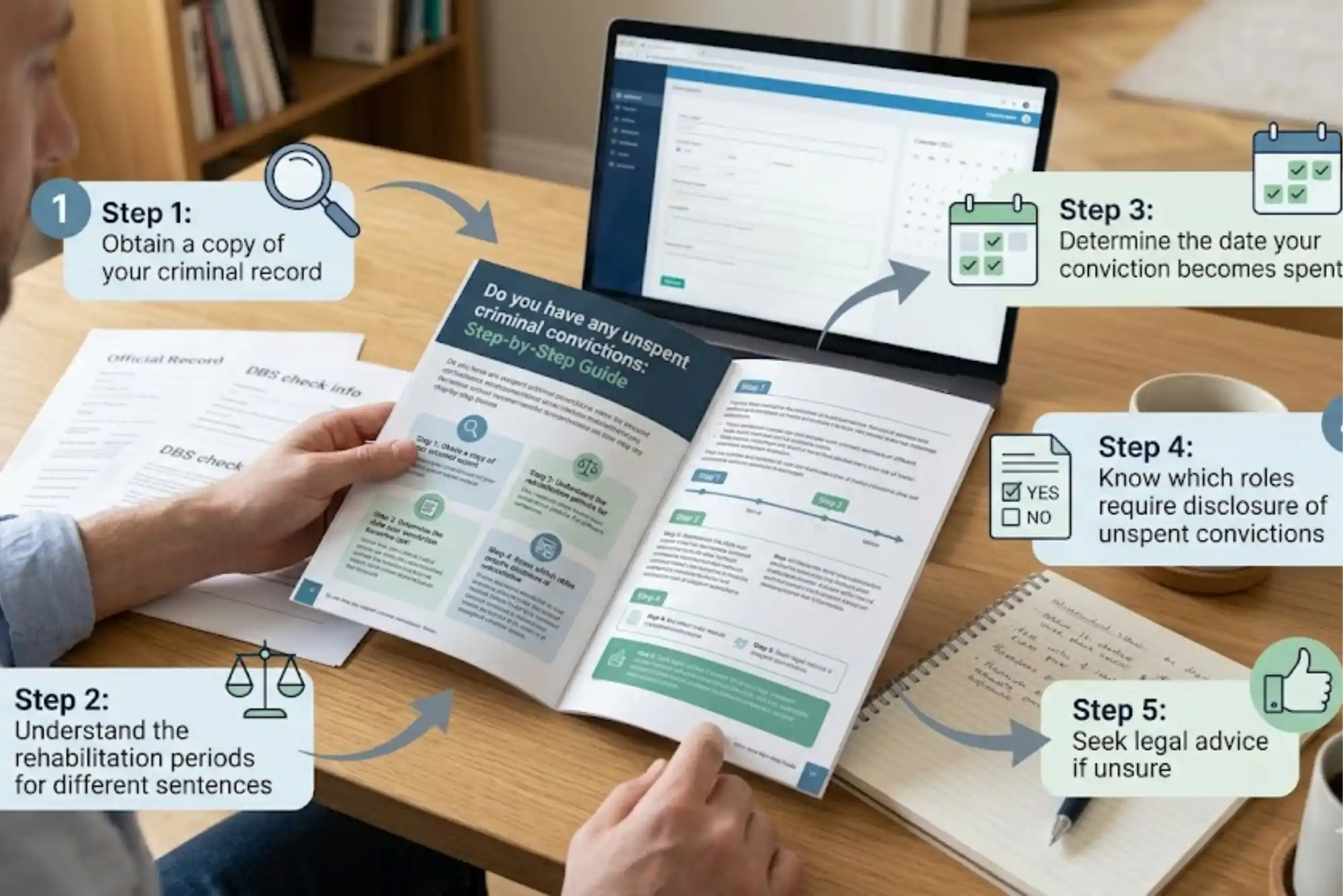
Step 1: Review Your Criminal Record
The first step is to obtain an official copy of your criminal record from the relevant authority. This document will list any convictions and provide essential details such as dates, charges, and outcomes.
If you are unsure how to access your record, consulting legal resources such as reliable legal knowledge hubs can help you understand the process and requirements.
Step 2: Understand the Rehabilitation Period
Each conviction is subject to a rehabilitation period, which varies depending on the severity of the offense and applicable laws. Minor offenses may have shorter periods, while serious crimes may take years or may never become spent.
Carefully reviewing the legal framework that applies to your situation is crucial for determining whether your conviction is still considered unspent.
Step 3: Identify the Nature of the Offense
Not all offenses are treated equally. Some convictions may never become spent, particularly those involving serious criminal activity. Understanding the classification of your offense will help clarify your disclosure obligations.
Legal professionals can provide insight into how specific offenses are categorized and how they impact your record.
Step 4: Seek Legal Advice if Unsure
If there is any uncertainty, seeking professional legal advice is strongly recommended. A qualified lawyer can interpret complex legal rules, assess your specific case, and provide accurate guidance.
For individuals in the UAE, consulting experienced legal professionals in Abu Dhabi can provide tailored advice based on local regulations.
Legal Implications of Non-Disclosure
Failing to disclose an unspent conviction when required can have serious consequences. These may include employment termination, visa refusal, or legal penalties depending on the situation.
In some cases, non-disclosure may be interpreted as dishonesty or misrepresentation, which can damage credibility and trust.
It is always safer to provide accurate information and seek clarification if needed, rather than risk the consequences of incomplete disclosure.
Real-World Scenarios and Examples
Consider a job applicant who was convicted of a minor offense several years ago. If the rehabilitation period has passed, the conviction may be considered spent, and disclosure may not be required in many cases.
On the other hand, an individual applying for a professional license with an unspent conviction may be required to disclose it, even if the offense was relatively minor. Regulatory bodies often have strict guidelines to ensure public trust and safety.
Similarly, visa applicants who fail to disclose unspent convictions may face delays or denials, even if the offense itself would not have disqualified them.
Common Misconceptions About Criminal Convictions
One common misconception is that all convictions must always be disclosed. In reality, disclosure requirements depend on whether the conviction is spent or unspent and the context in which the question is asked.
Another misunderstanding is that minor offenses automatically become irrelevant over time. While many do, the timeline and conditions vary, and assumptions can lead to errors.
There is also a belief that authorities cannot access past records. In many cases, background checks and official databases can reveal information, making honesty essential.
Conclusion
Understanding whether you have any unspent criminal convictions is not just a legal technicality—it is a critical step in protecting your personal and professional future.
By reviewing your record, understanding applicable laws, and seeking professional guidance when necessary, you can navigate disclosure requirements with confidence and accuracy.
Ultimately, transparency and informed decision-making are key. Whether applying for a job, visa, or professional license, knowing your legal position ensures that you avoid unnecessary risks and move forward with clarity.