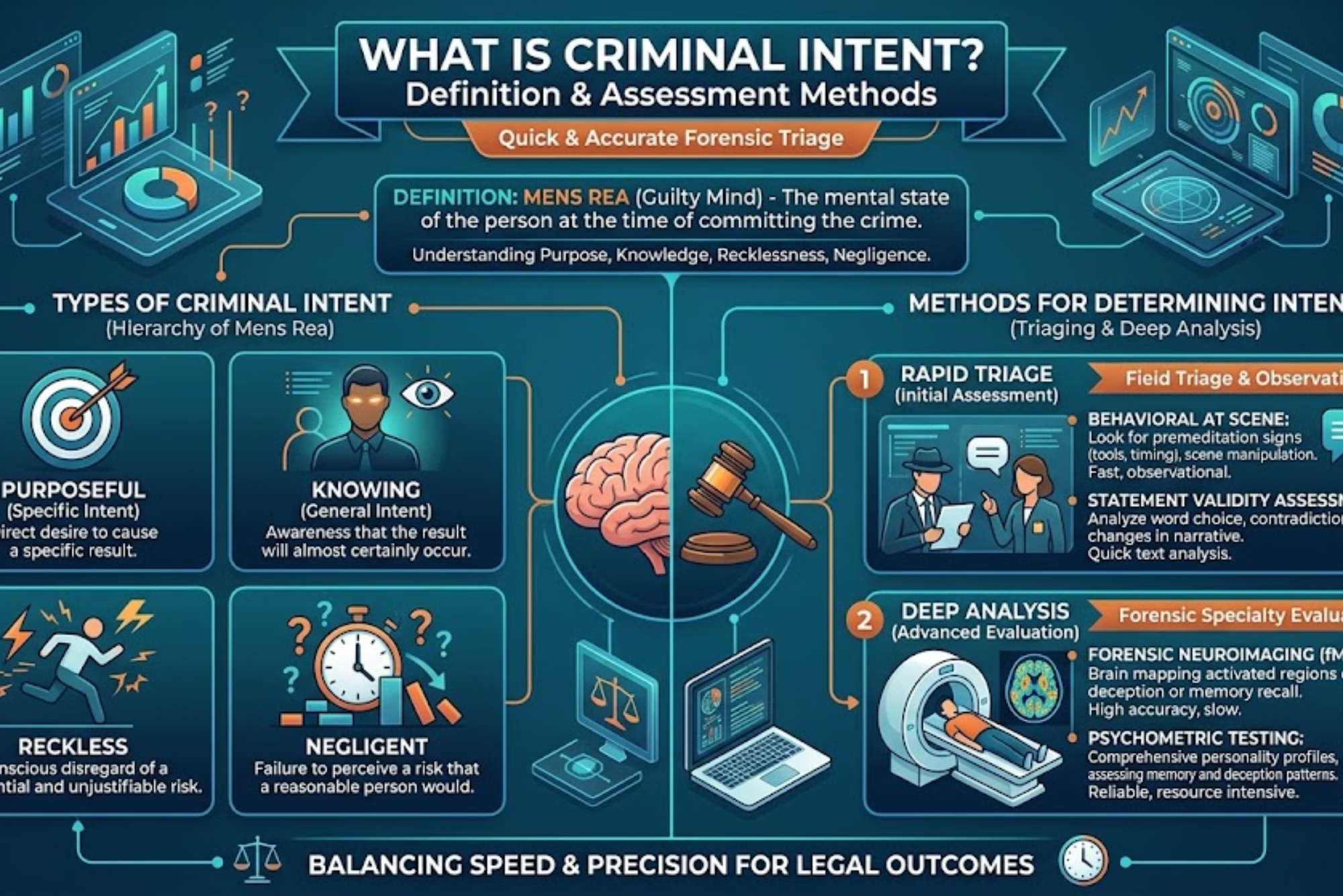
In criminal law, actions alone are not always enough to establish guilt. Courts must also determine what was going on in the mind of the accused at the time of the act. This mental element is known as criminal intent, and it plays a decisive role in determining whether a person can be held legally responsible.
Understanding criminal intent is essential not only for legal professionals but also for business owners, compliance officers, and individuals navigating complex legal environments. It distinguishes between deliberate wrongdoing and accidental behavior, shaping how justice is applied.
What Is Criminal Intent in Law?
Criminal intent, often referred to by the legal term mens rea, describes the mental state of a person when committing a crime. It answers a critical question: did the individual intend to commit the unlawful act, or was it a mistake, accident, or oversight?
In most legal systems, proving criminal intent is necessary to establish liability. Without it, many actions—even if harmful—may not meet the threshold for criminal punishment. This principle ensures fairness and prevents individuals from being punished for unintended consequences.
Why Criminal Intent Matters in Legal Cases
Criminal intent is fundamental because it separates different levels of wrongdoing. For example, intentionally causing harm is treated far more seriously than causing harm through negligence.
Courts rely on intent to determine the severity of charges, appropriate penalties, and whether a crime has occurred at all. This is particularly important in complex legal systems, where businesses and individuals must comply with various regulations. In such contexts, seeking guidance from experienced professionals—such as those listed on legal experts in Abu Dhabi—can help clarify obligations and risks.

Types of Criminal Intent
Criminal intent is not a single concept. It exists in different forms, each reflecting a different level of awareness and responsibility.
Intentional (Direct Intent)
This is the clearest form of criminal intent. It occurs when a person deliberately plans and executes an unlawful act. The outcome is not accidental—it is the intended result of the individual’s actions.
Recklessness
Recklessness arises when a person is aware of a significant risk but chooses to ignore it. While there may not be a direct intention to cause harm, the conscious disregard for consequences makes the behavior legally culpable.
Negligence
Negligence involves a failure to exercise reasonable care. Unlike recklessness, the individual may not be aware of the risk, but they should have been. This type of intent often appears in cases involving professional or corporate responsibilities.
Strict Liability
In certain cases, the law imposes liability without requiring proof of intent. These are known as strict liability offenses and are commonly found in regulatory areas such as environmental law and corporate compliance. For deeper insights into related legal frameworks, readers may explore corporate and regulatory legal practices.
Quick & Accurate Methods to Determine Criminal Intent
Because intent exists in the mind, it cannot be observed directly. Courts rely on structured methods to infer intent from evidence and behavior.
Analyzing Actions and Circumstances
The first step is to examine what the accused did and under what circumstances. Actions often speak louder than words. For instance, repeated behavior or careful planning may indicate deliberate intent.
Evaluating Statements and Behavior
Statements made before, during, or after the incident can provide valuable insight into intent. Emails, messages, and verbal communications are often used to establish what the individual was thinking.
Reviewing Evidence and Documentation
Physical and digital evidence plays a crucial role in determining intent. Documents, contracts, financial records, and surveillance footage can all help reconstruct the sequence of events.
Inferring Intent from Outcomes
In some cases, intent is inferred from the natural consequences of actions. If a reasonable person would expect a certain outcome, the court may conclude that the accused intended that result.
Real-World Examples of Criminal Intent
Consider a scenario where an individual deliberately falsifies financial records to gain an advantage. This demonstrates clear intent, as the act is planned and executed with a specific goal in mind.
In contrast, a company that fails to implement proper safety measures may face negligence claims. While there may be no deliberate intent to cause harm, the lack of reasonable care can still result in legal consequences.
Another example involves regulatory violations, where businesses may be held liable even without intent. These cases highlight the importance of understanding compliance obligations and seeking professional legal advice when necessary.
Challenges in Proving Criminal Intent
Proving criminal intent is one of the most complex aspects of legal proceedings. Since intent is internal, it must be inferred from external evidence, which may be incomplete or ambiguous.
Defense strategies often focus on creating doubt about intent, arguing that the act was accidental or misunderstood. Prosecutors, on the other hand, must present a clear and convincing narrative supported by evidence.
Cultural, psychological, and situational factors can also complicate the interpretation of intent, making each case unique.
Legal Implications of Criminal Intent
The presence or absence of criminal intent directly affects legal outcomes. It influences whether charges are filed, the type of charges, and the severity of penalties.
For businesses, understanding criminal intent is especially important in risk management and compliance. Failure to recognize legal responsibilities can lead to significant financial and reputational damage.
Legal systems emphasize intent to ensure fairness, preventing individuals from being punished for actions they did not consciously or negligently commit.
Conclusion
Criminal intent is a foundational concept in law that determines how responsibility is assigned and justice is delivered. It ensures that punishment is not based solely on actions but also on the mindset behind those actions.
By understanding the different types of intent and the methods used to evaluate it, individuals and organizations can better navigate legal challenges and avoid unnecessary risks. In an increasingly regulated world, awareness of criminal intent is not just a legal necessity—it is a practical safeguard for responsible decision-making.