In the world of law and justice, psychology plays a powerful role in understanding human behavior, decision-making, and criminal intent. However, many people often assume that criminal psychology and forensic psychology are the same. While they are closely related, they serve distinct purposes within the legal system.
Understanding the difference between these two fields is not just an academic exercise—it has real implications for how crimes are investigated, how trials are conducted, and how justice is ultimately delivered. This article provides a clear, expert-driven explanation of criminal psychology vs forensic psychology, using simple frameworks and real-world examples to clarify their roles.
Understanding Criminal Psychology
Criminal psychology focuses on understanding the thoughts, motivations, and behaviors of individuals who commit crimes. It seeks to answer questions such as: Why do people commit crimes? What psychological factors influence criminal behavior? Are certain personality traits more likely to lead to unlawful actions?
Criminal psychologists often study patterns of behavior, emotional triggers, and environmental influences that shape criminal activity. Their work may involve analyzing past crimes, developing psychological profiles, and assisting law enforcement in identifying potential suspects.
This field is deeply rooted in behavioral science and emphasizes prevention, prediction, and understanding of criminal actions rather than legal procedures.
Understanding Forensic Psychology
Forensic psychology, on the other hand, operates at the intersection of psychology and the legal system. It applies psychological principles directly within legal contexts, including court proceedings, criminal investigations, and correctional systems.

Forensic psychologists may evaluate a defendant’s mental state, assess competency to stand trial, provide expert testimony, or assist in jury selection. Their role is more structured around legal processes and standards.
Unlike criminal psychologists, forensic psychologists often work closely with lawyers, judges, and law enforcement agencies to ensure that psychological insights are applied appropriately within the justice system.
Key Differences Between Criminal Psychology and Forensic Psychology
Scope and Focus
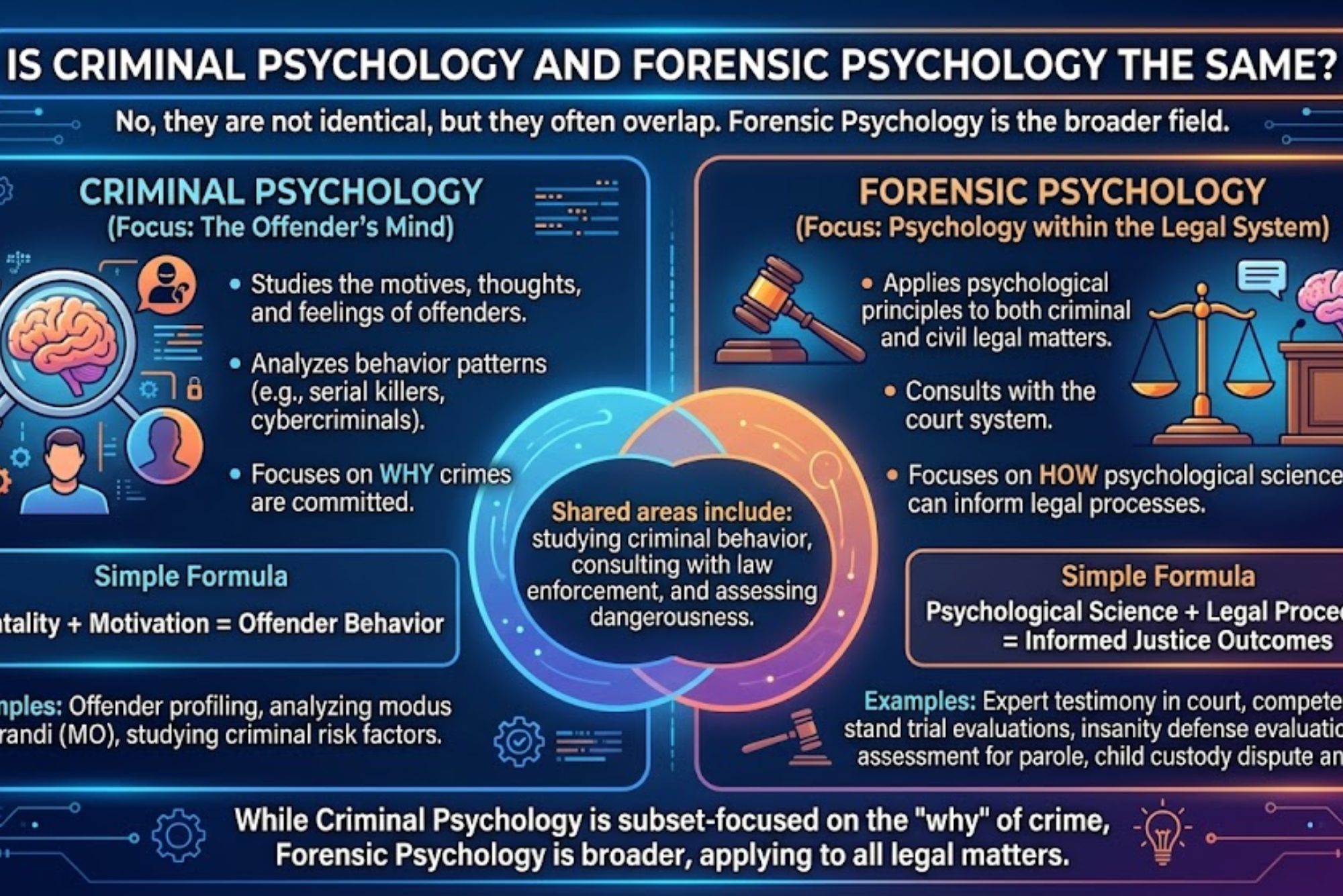
The primary difference lies in their focus. Criminal psychology is concerned with understanding criminal behavior, while forensic psychology focuses on applying psychological knowledge within legal settings.
In simple terms, criminal psychology asks “why crimes happen,” while forensic psychology asks “how psychology can help the legal system handle crimes.”
Work Environment
Criminal psychologists often work in research institutions, law enforcement agencies, or academic settings. Their work may involve analyzing crime data, studying behavioral trends, or developing offender profiles.
Forensic psychologists typically work in courts, legal offices, prisons, or rehabilitation centers. Their daily tasks are closely tied to legal procedures and case evaluations.
Role in Legal System
Criminal psychologists support investigations by offering insights into offender behavior. However, they are less likely to be directly involved in court proceedings.
Forensic psychologists play a direct role in legal cases. They may provide expert testimony, conduct psychological assessments, and assist in legal decision-making.
Methods and Approaches
Criminal psychology relies heavily on behavioral analysis, case studies, and psychological theories. It often involves profiling and pattern recognition.
Forensic psychology uses clinical assessments, legal standards, and structured evaluations to determine mental competency, risk levels, and credibility.
Simple Formulas to Understand the Difference
To simplify the distinction, consider these easy-to-remember formulas:
Criminal Psychology = Behavior Analysis + Motivation + Crime Patterns
Forensic Psychology = Psychology + Law + Court Application
These formulas highlight the core difference: one focuses on understanding criminals, while the other focuses on applying psychology within the legal system.
Real-World Examples
Imagine a situation where law enforcement is investigating a series of similar crimes. A criminal psychologist might analyze the crime scenes, identify behavioral patterns, and develop a profile of the likely offender. This helps narrow down suspects and guide the investigation.
In contrast, during a court trial, a forensic psychologist may evaluate whether the accused individual is mentally fit to stand trial. They might also assess whether the defendant understood the consequences of their actions at the time of the crime.
Another example involves rehabilitation. Criminal psychologists may study why certain individuals reoffend, while forensic psychologists may design treatment programs or provide evaluations for parole decisions.
Why the Distinction Matters in Legal Practice
Understanding the difference between these two fields is crucial for legal professionals. Each plays a unique role in ensuring that justice is both effective and fair.
For instance, accurate psychological profiling can help solve complex cases, while proper forensic evaluations ensure that legal decisions are informed by mental health considerations. This distinction also helps courts rely on the right type of expert at the right stage of a case.
In modern legal systems, integrating psychological expertise has become essential for handling sensitive cases, including those involving mental illness, violent crimes, and juvenile offenders.
Common Misconceptions
One of the most common misconceptions is that both fields are interchangeable. While they overlap in certain areas, their objectives and applications are clearly different.
Another misconception is that both roles involve criminal profiling. In reality, profiling is primarily associated with criminal psychology, while forensic psychology focuses more on legal evaluations and court-related work.
There is also a tendency to assume that forensic psychologists only work with criminals. In fact, they may also work with victims, witnesses, and legal professionals.
Conclusion
Criminal psychology and forensic psychology are closely related but fundamentally different disciplines. One seeks to understand the mind of the offender, while the other applies psychological knowledge within the framework of the law.
By clearly distinguishing between these fields, legal professionals, students, and researchers can better appreciate their unique contributions to the justice system. Both play vital roles in ensuring that investigations are informed, trials are fair, and outcomes are just.
In an increasingly complex legal landscape, the collaboration between psychology and law continues to evolve, making these disciplines more important than ever.