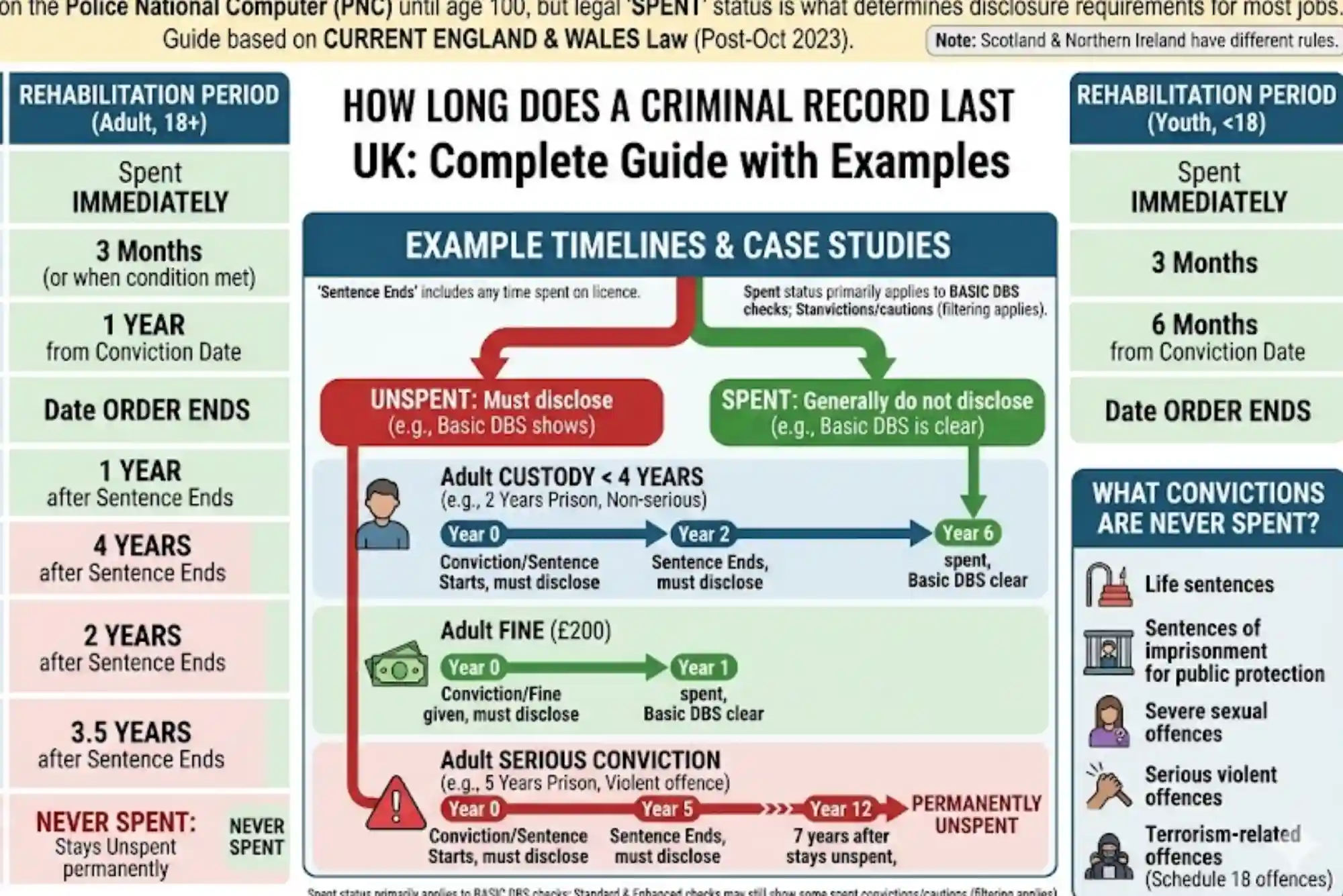
Understanding how long a criminal record lasts in the UK is essential for anyone navigating the legal system, seeking employment, or planning their future after a conviction. A criminal record does not simply disappear overnight, but it also does not always follow you forever in the way many people assume.
The reality is more nuanced. UK law provides a structured system that determines how long convictions remain relevant, when they become “spent,” and what must be disclosed in different situations. This guide breaks down those rules in a clear, practical way, supported by real examples to help you understand how they apply in everyday life.
What is a Criminal Record in the UK?
A criminal record is an official record of an individual’s interactions with the criminal justice system. It typically includes convictions, cautions, reprimands, and warnings issued by courts or law enforcement authorities.
This record is maintained by government systems and may be disclosed during background checks, particularly when applying for jobs, visas, or professional licenses. However, not all entries remain relevant forever. UK law recognizes the importance of rehabilitation and allows certain convictions to become legally “spent.”
How Long Does a Criminal Record Last in the UK?
Technically, a criminal record is retained indefinitely on official databases. However, the key distinction lies in whether a conviction is considered “spent” or “unspent” under the Rehabilitation of Offenders Act 1974.
Unspent vs Spent Convictions
An unspent conviction is one that must still be disclosed when asked, such as during job applications or legal proceedings. A spent conviction, on the other hand, is treated as if it has effectively expired for most purposes, meaning you usually do not need to disclose it.

Once a conviction becomes spent, individuals are legally entitled to move forward without being required to declare it in most circumstances. This legal protection plays a vital role in supporting rehabilitation and reintegration into society.
Rehabilitation Periods Explained
The length of time it takes for a conviction to become spent depends on the type and severity of the sentence, rather than the offence itself. For example:
A fine may become spent after a relatively short period, while a custodial sentence will take significantly longer. More serious sentences, particularly those exceeding a certain length, may never become spent.
Importantly, rehabilitation periods typically begin from the end of the sentence, not the date of conviction. This distinction can significantly affect the timeline.
Factors That Affect How Long a Record Lasts
Several factors influence how long a criminal record remains relevant in legal and practical terms. The most significant include the type of offence, the severity of the sentence, and the age of the individual at the time of conviction.
For example, younger offenders often benefit from shorter rehabilitation periods, reflecting the legal system’s emphasis on giving individuals a second chance. Similarly, non-custodial sentences tend to have shorter durations compared to imprisonment.
The nature of the offence can also play a role, particularly when it comes to disclosure requirements for certain professions, such as healthcare, education, or law enforcement.
What Does “Spent” Mean in Practice?
When a conviction becomes spent, it does not mean it is erased from official records. Instead, it means that, in most cases, the individual is no longer legally required to disclose it.
This distinction is critical. For example, when applying for most jobs, a candidate with a spent conviction can legally answer “no” when asked about criminal history. Employers are generally not permitted to discriminate based on spent convictions in these contexts.
However, there are exceptions. Certain roles, particularly those involving vulnerable individuals or high levels of trust, may still require full disclosure.
Criminal Record Disclosure and DBS Checks
Disclosure of criminal records in the UK is primarily managed through the Disclosure and Barring Service (DBS). The type of check required depends on the nature of the role or situation.
Basic DBS Checks
A basic DBS check reveals only unspent convictions. This is the most common type of background check and is typically used for general employment purposes.
Standard and Enhanced DBS Checks
Standard and enhanced checks provide more detailed information, including both spent and unspent convictions. Enhanced checks may also include additional information held by local police, depending on the role.
These higher-level checks are usually required for positions involving children, vulnerable adults, or sensitive responsibilities.
Real-Life Examples of Criminal Record Timelines
Consider an individual who receives a fine for a minor offence. In many cases, this conviction becomes spent after a relatively short rehabilitation period, allowing the individual to move forward without ongoing disclosure requirements.
In contrast, someone who receives a custodial sentence of several years may face a much longer rehabilitation period. In some cases, particularly with longer sentences, the conviction may never become spent, meaning it must always be disclosed.
Another example involves a young offender receiving a caution. This may become spent quickly, reflecting the legal system’s focus on rehabilitation and minimizing long-term consequences for minor offences.
Can a Criminal Record Be Removed or Cleared?
In general, criminal records are not removed or deleted from official systems. However, certain records may be filtered after a period of time, meaning they no longer appear on some types of background checks.
Filtering rules are complex and depend on factors such as the type of offence and the number of convictions. This process is separate from the concept of spent convictions and operates under its own legal framework.
In rare cases, individuals may apply to have incorrect or unlawful records amended, but this is not the same as clearing a valid conviction.
Impact of a Criminal Record on Employment and Travel
A criminal record can have significant implications for employment opportunities, particularly when convictions are unspent or subject to disclosure through DBS checks.
Some employers may be more cautious when hiring individuals with certain types of convictions, especially in regulated industries. However, many organizations now adopt fair hiring practices that consider the context and relevance of an offence.
Travel can also be affected, as some countries require disclosure of criminal history during visa applications. The impact varies depending on the destination and the nature of the conviction.
Key Legal Considerations and Rights
Individuals with criminal records in the UK have important legal rights. These include protection against unfair discrimination in many employment contexts and the right not to disclose spent convictions in most situations.
Understanding these rights is essential for navigating life after a conviction. Legal advice may be particularly valuable when dealing with complex cases or professional requirements.
Conclusion
The question of how long a criminal record lasts in the UK does not have a simple, one-size-fits-all answer. While records are technically retained indefinitely, their practical impact changes over time through the concept of spent convictions and disclosure rules.
By understanding rehabilitation periods, disclosure requirements, and legal rights, individuals can better navigate their future and make informed decisions. Ultimately, the UK legal system aims to balance accountability with the opportunity for rehabilitation, allowing individuals to move forward while maintaining public trust.