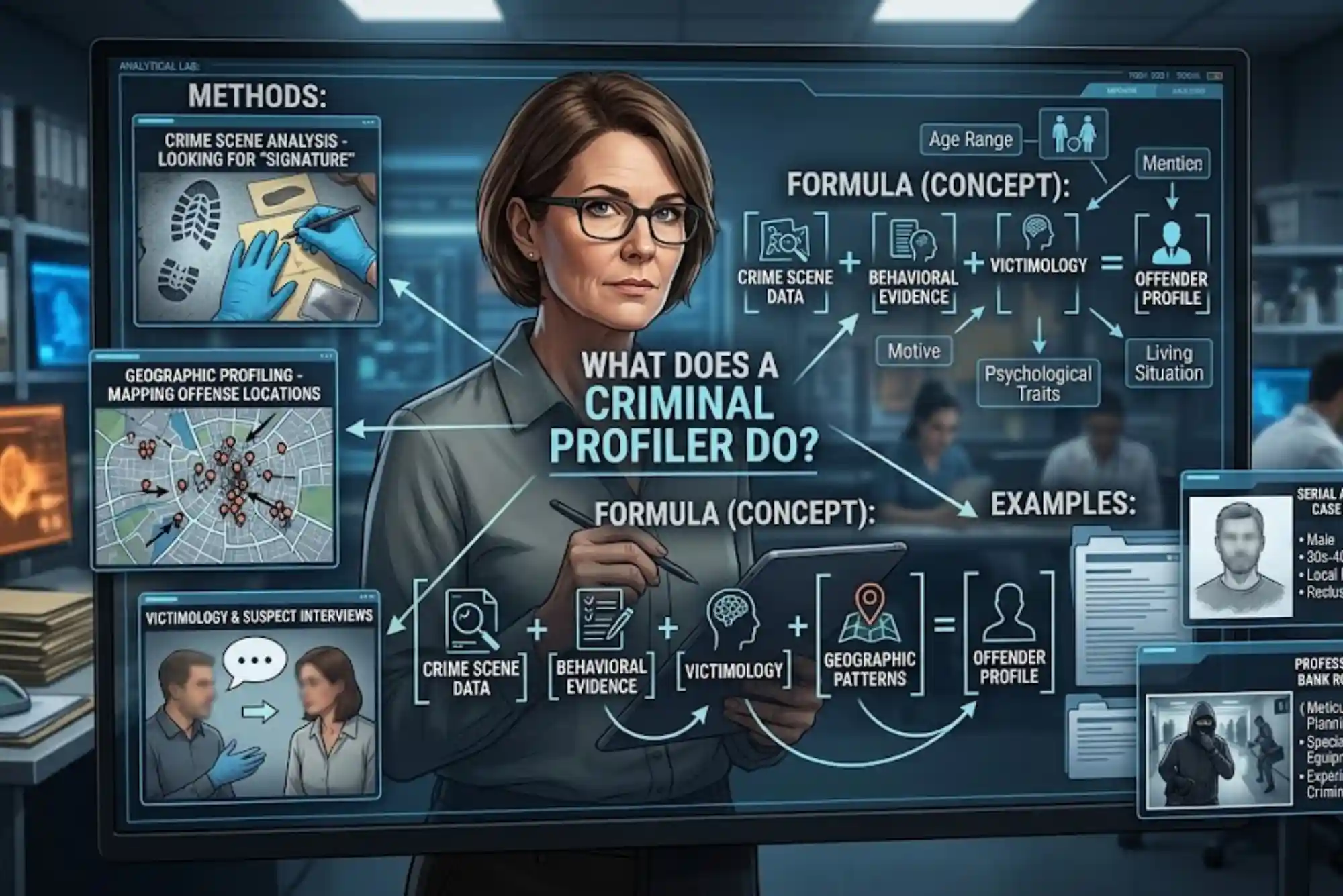
Criminal profiling is one of the most fascinating and misunderstood areas of modern criminal investigation. Popularized by films and television, it is often portrayed as an almost mystical ability to “read minds.” In reality, a criminal profiler relies on structured psychological analysis, behavioral patterns, and investigative experience to help law enforcement understand unknown offenders.
At its core, criminal profiling is not about guessing who committed a crime. Instead, it is about analyzing evidence left behind at a crime scene to build a behavioral and psychological portrait of the offender. This helps investigators narrow down suspects and understand how and why a crime was committed.
What Does a Criminal Profiler Do?
A criminal profiler is a trained specialist—often with a background in psychology, criminology, or law enforcement—who analyzes criminal behavior patterns. Their job is to assist investigators by interpreting evidence in ways that reveal the likely characteristics of an unknown offender.
They do not replace traditional investigation methods. Instead, they support detectives by offering insights into personality traits, behavioral tendencies, possible motives, and even potential future actions of the suspect.
In many cases, criminal profilers work closely with specialized units such as behavioral analysis teams, forensic departments, and homicide divisions. Their analysis is particularly useful in complex or repetitive crimes such as serial offenses.
Core Methods Used in Criminal Profiling
1. Crime Scene Analysis
Crime scene analysis is one of the most important starting points in profiling. Investigators examine how the crime was committed, what evidence was left behind, and how the offender interacted with the environment.

A profiler studies whether the crime scene appears organized or disorganized. An organized crime scene may suggest planning, control, and experience, while a disorganized scene may indicate impulsivity or emotional instability.
2. Victimology
Victimology focuses on understanding the victim’s life, habits, relationships, and vulnerabilities. By studying why a particular victim was chosen, profilers can identify patterns that may link multiple crimes together.
For example, if multiple victims share similar demographics or routines, it may suggest a targeted selection process by the offender.
3. Behavioral Pattern Recognition
One of the key tasks of a criminal profiler is identifying behavioral patterns across crimes. These patterns can include methods of approach, communication styles, timing of attacks, or post-crime behavior.
Repeated behaviors often form a “behavioral signature,” which is unique to the offender and can help link crimes to a single individual.
4. Geographic Profiling
Geographic profiling examines the locations of crimes to determine where an offender might live or operate. Offenders often commit crimes within a “comfort zone” that is familiar but not too close to their residence.
Mapping crime locations helps investigators identify probable zones where the suspect may reside or frequently travel.
Is There a Formula for Criminal Profiling?
Unlike mathematics or engineering, criminal profiling does not rely on a fixed formula. However, it follows structured analytical frameworks that guide decision-making. These frameworks combine psychology, criminology, and investigative logic.
A simplified conceptual model often used in profiling can be understood as:
Crime Scene Evidence + Victimology + Behavioral Patterns + Geographic Data = Offender Profile Hypothesis
This “formula” is not exact or predictive in a scientific sense, but it helps investigators organize complex information into a structured behavioral hypothesis.
Key Approaches in Criminal Profiling
Inductive Profiling
Inductive profiling relies on statistical analysis and previous criminal cases. Profiler assumptions are based on patterns observed in similar offenders. For example, if past data shows that certain crimes are often committed by individuals with specific behavioral traits, those traits may be applied to current investigations.
While useful, inductive profiling can sometimes be too general, as it relies heavily on group behavior rather than individual uniqueness.
Deductive Profiling
Deductive profiling is more case-specific. It focuses entirely on evidence from the current crime scene without relying heavily on historical data. The profiler builds conclusions based on direct physical and behavioral evidence.
This method is often considered more precise but requires a high level of expertise and detailed crime scene information.
Psychological Profiling
Psychological profiling examines the mental and emotional state of the offender. It aims to understand motivations such as anger, control, financial gain, or psychological gratification.
By analyzing these motivations, investigators can better predict future behavior and narrow down suspect lists.
Real-World Applications of Criminal Profiling
Criminal profiling has been used in a wide range of investigations, particularly in cases involving serial offenders or complex behavioral patterns. Law enforcement agencies, including behavioral analysis units, use profiling to support investigations that lack clear physical evidence.
For example, in cases where multiple crimes share similar behavioral signatures, profiling helps determine whether they are connected or committed by different individuals.
Profilers also assist in hostage situations, terrorism-related investigations, and threat assessments by analyzing communication patterns and psychological indicators.
Example Scenario: How Profiling Works in Practice
Imagine a series of burglaries occurring in different neighborhoods, all happening late at night. In each case, entry is made through unlocked windows, and no valuables of high value are taken—only personal items.
A criminal profiler analyzing this pattern may conclude that the offender is not financially motivated but psychologically driven. The choice of personal items suggests emotional or symbolic intent rather than profit.
By combining this insight with geographic patterns, investigators may narrow down suspects who live nearby and have familiarity with the area.
Limitations of Criminal Profiling
Despite its usefulness, criminal profiling is not an exact science. It cannot directly identify a suspect or guarantee accuracy in every case.
One major limitation is subjectivity. Different profilers may interpret the same evidence differently, leading to varying conclusions. Additionally, profiling works best when combined with traditional investigative techniques such as forensic analysis and witness testimony.
Another challenge is the risk of confirmation bias, where investigators may focus too heavily on a profile and overlook contradictory evidence.
The Importance of Criminal Profiling in Modern Investigations
Even with its limitations, criminal profiling remains a valuable tool in modern law enforcement. It helps reduce suspect pools, guides investigative direction, and provides psychological insight into unknown offenders.
As crime becomes more complex, especially in digital environments, profiling continues to evolve. Modern profilers increasingly integrate data analytics, digital behavior tracking, and advanced forensic psychology into their work.
Conclusion: Understanding the Role of Criminal Profilers
A criminal profiler plays a critical role in bridging psychology and law enforcement. By analyzing behavior, evidence, and patterns, they help investigators understand the mind behind the crime.
While there is no strict formula for criminal profiling, structured methodologies such as behavioral analysis, victimology, and geographic profiling provide a reliable framework for investigation.
Ultimately, criminal profiling is not about predicting crime with certainty—it is about improving understanding, narrowing possibilities, and supporting justice through informed investigative insight.